How The Illusion of Spectrum Crisis Paved the Way for Duopoly Dominance
NT and MVNOS blocked by Thailand’s telecom regulator (NBTC) who instead paved the way for AIS and TRUE
Over the weekend, Thailand’s National Broadcasting and Telecommunications Commission (NBTC), released articles that were printed by local media without any questions or comments, where the NBTC asserted a desperate need for more spectrum.
They hailed their August auction as the solution to this “crisis,” showcasing how they’ve secured the country’s digital future.
However, when reading the articles, you will realize, this is not a story about a “spectrum crisis.” It is a careful deconstruction of a narrative crafted by the NBTC to justify the transfer of public assets into the hands of Thailand’s two dominant operators, AIS and TRUE.
The NBTC’s recent auctions did not increase the amount of available spectrum in the market; they simply shifted control of frequencies already in active use by the state-owned National Telecom (NT) and Mobile Virtual Network Operators (MVNOs), as well as AIS and TRUE.
This strategic move, effectively killed any chance of possible competition.
A Critical Detail Overlooked
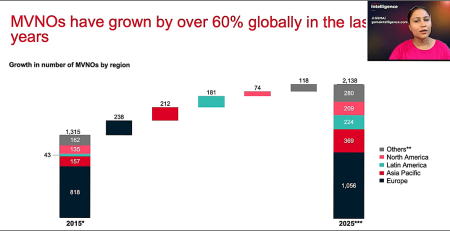
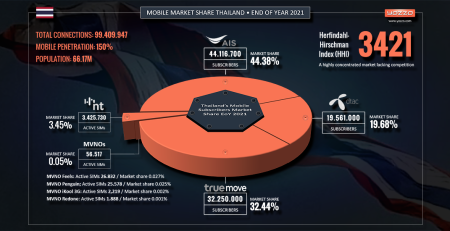
The most damaging consequence of this NBTC play has been the collapse of Thailand’s Mobile Virtual Network Operator (MVNO) market.
When the spectrum was under the state-owned National Telecom (NT), it was the only network open to MVNOs. This allowed smaller operators to lease capacity, fostering competition and offering consumers alternatives.
The moment NT’s spectrum was auctioned away, every MVNO in Thailand was forced to cease operations entirely, and that is exactly what happened on August 1st 2025.
Although AIS and TRUE are legally required under their licenses (since 2013) to provide capacity for MVNOs—10% for AIS and, and following the TRUE–DTAC merger, 20% for TRUE—neither operator has opened its networks.
The result is a telecom landscape with no MVNO presence, in stark contrast to other markets where MVNOs are essential drivers of affordability and innovation.
The NBTC kept crying wolf and warned of an impending “spectrum crisis,” projecting a demand of 615 MHz by the end of 2025 and claiming that without additional auctions, Thailand would face a shortfall, leading to slower internet speeds and unstable mobile signals. This alarming forecast served as the primary justification auctioning spectrum licenses.
However, a critical detail overlooked in the NBTC’s public pronouncements is that the spectrum in question was not lying dormant. Far from it, these bands were actively in use, forming integral parts of Thailand’s mobile network infrastructure through various agreements involving NT, MVNOs and the two private behemoths, AIS and TRUE.
The Reality of "Existing" Spectrum
For years, AIS leveraged the 2100 MHz band through its partnership with the former TOT (now part of NT). Similarly, TRUE (and previously dtac before its merger) utilized the 2300 MHz spectrum via agreements with the former TOT and CAT Telecom (also now part of NT).
These partnerships allowed AIS and TRUE to expand their network capacity, serve millions of customers, and maintain their market leadership without outright owning these particular frequency licenses.
When the licenses for these bands neared their expiration, the NBTC is now framing it as a looming national catastrophe if they weren’t re-auctioned.
The implication they use is that without these specific auctions, Thailand would suddenly lose over 100 MHz of crucial spectrum, plunging the nation into digital darkness.
The reality was that this spectrum was already deployed and serving millions of customers through the networks of the two main private operators and MVNOs.
The NBTC’s auction did NOT introduce new spectrum into the market, instead it killed to flies in one hit: it simply facilitated the transfer of licenses from a state-owned enterprise to the two largest private companies, and killed any possible chance of competition from MVNOs or NT.
Consolidating Power: The Duopoly's Gain
The outcome of the June 2025 auction—where AIS and TRUE were the only bidders—solidified their control over these valuable assets.
NT’s president and board decided not to participate in the auction. Interesting because NT is a shareholder in TRUE.
By owning a stake in TRUE, NT stands to gain financially from the very market consolidation that it was supposed to prevent. This created a clear incentive for NT to exit the MVNO market and avoid competitive action, thereby boosting the value of its investment in TRUE.
A visual breakdown of spectrum holdings after the auction, demonstrates this transfer of power with striking clarity:
Chart showing the spectrum holding per operator in MHz.
- AIS now holds a total of 1460 MHz including the 2100 MHz (2x15MHz) license that was “Transferred from NT” and has a new expiration date of 2036.
- TRUE now holds a total of 1350 MHz including the substantial 70 MHz block of the 2300 MHz band that was used by NT, with a long-term license expiring in 2040.
- In stark contrast, the state-owned National Telecom (NT) is left with a mere 10 MHz of spectrum, whereof half of it, is to be used by AIS. A significant reduction that has effectively neuters its ability to compete in the mobile market and host any MVNOs.
By acquiring direct ownership of the 2100 MHz and 2300 MHz bands, AIS and TRUE secured uninterrupted access to spectrum they were already utilizing.
This eliminated their reliance on temporary agreements with NT, giving them full control over a vital component of their network infrastructure for years to come.
Simultaneously, the re-auction effectively stripped NT of its most valuable spectrum assets, leaving it as a diminished player and further cementing the market dominance of AIS and TRUE.
The Illusion of a Spectrum Crisis and the Cost of Privatization
In essence, the NBTC’s “spectrum crisis” narrative created an illusion of scarcity where none truly existed in terms of active utilization.
It transformed a situation of expiring state-owned licenses, already integrated into the private operators’ networks, into an urgent national necessity for new auctions.
While this strategic framing generated a one-time revenue of 41 billion baht, it came at a staggering long-term cost, with critics estimating a loss of over 70 billion baht for the state in sacrificed revenue.
But not only did this inappropriate pricing allow the two private companies to significantly reduce their operational costs, it paved a clear path for AIS and TRUE to solidify their long-term control over critical spectrum assets, cementing their duopolistic grip on Thailand’s telecommunications market.
The NBTC’s internal board vote on the auction results was not unanimous, with a 5-1-1 split (five in favor, one against, one abstaining), highlighting internal disagreement.
Furthermore, Thailand Consumer Council filed a lawsuit against the NBTC in the Central Administrative Court, seeking to nullify the auction and arguing that it harms consumer interests. The court has accepted the case for a full legal review, signaling the seriousness of the allegations against the regulator.
This might be the reason for NBTC’s un-edited “spectrum crisis” articles over the weekend in mainstream media. However, in their rush, the NBTC is caught with their pants around their knees, as they did NOT add any additional spectrum to the market.
Questions remain—rhetorical, uncomfortable but unavoidable—about whether the NBTC’s regulatory approach truly serves the broader public interest by fostering a competitive and innovative telecom landscape, or if it inadvertently acts as an enabler for the market’s most powerful players.
- Why was NT not supported to retain and expand its spectrum?
- Why did NBTC permit the effective destruction of Thailand’s MVNO market?
- Why have AIS and True not been held accountable for ignoring license conditions to support MVNOs?
- And most importantly — is the regulator protecting consumers, or protecting the duopoly?