Thailand’s MVNO Sector Died Today Due to Regulatory Failure
This is custom heading element
MVNOs in Thailand ✝ 2009 – 2025.
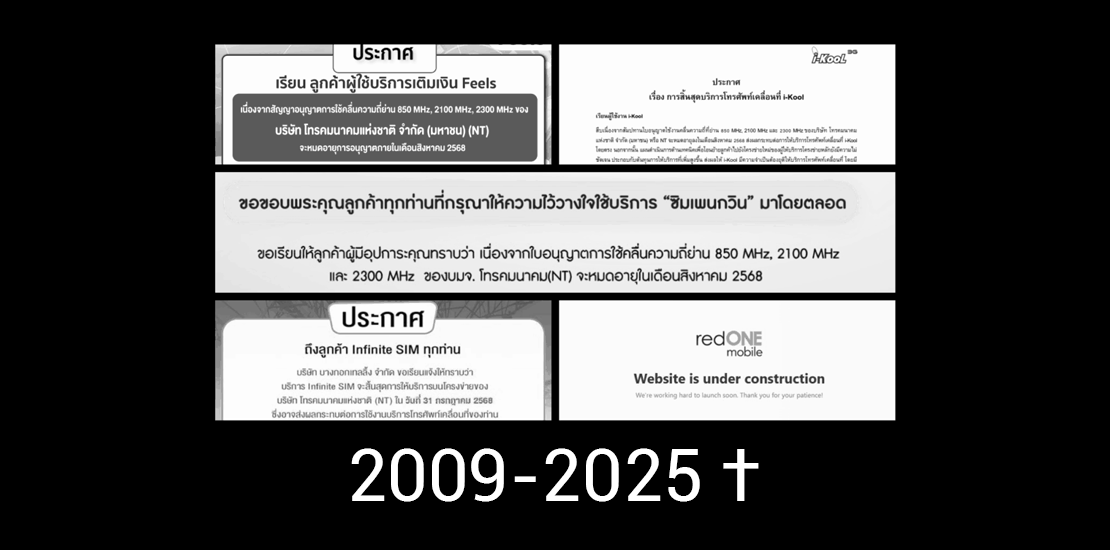
Today, August 1, 2025, marks the official end for Thailand’s mobile virtual network operators (MVNO). All five remaining MVNOs — i-Kool, Penguin SIM, Feels Telecom, Infinite SIM, and Redone — have ceased their services.
This collapse, is not the result of a competitive market but a direct consequence of a decade of inaction and dereliction of duty by the National Broadcasting and Telecommunications Commission (NBTC).
The demise of the MVNOs exposes a fundamental flaw in Thai telecommunications regulation. Despite getting paid for and issuing over 65 MVNO licenses, the NBTC has consistently turned a blind eye to enforce their end of the deal.
Regulatory Neglect and Unenforced Rules
For more than a decade, the NBTC has been nothing but a silent spectator. It has stood by as the dominant mobile network operators (MNOs) routinely ignored a key regulation in place since 2013: the mandate requiring them to allocate at least 10% of their network capacity to MVNOs.
This critical condition, designed to ensure fair access to infrastructure, was rendered meaningless by the NBTC’s utter failure to enforce it.
The final blow came with the recent auction of National Telecom’s (NT) spectrum. With NT’s capacity drastically reduced to a mere 5MHz, the state operator announced it would not be able to support the MVNOs who relied on its network anymore.
This forced them to turn (again) to the very MNOs — AIS and the merged TRUE/DTAC — who have actively resisted the mandated wholesale access, and the NBTC wilfully ignored it.
The NBTC’s promises of “fair, reasonable, non-discriminatory” access have proven to be hollow words, a reality demonstrated by the formal dispute cases some MVNOs have been forced to file against the MNOs simply to gain access to the mandated capacity.
The public statements from the defunct MVNOs leave no room for ambiguity:
- Infinite SIM: “Bangkok Telling Co., Ltd. would like to inform you that Infinite SIM service will end its service on the National Telecom (NT) network on July 31, 2025, which will affect your mobile phone service. The company recommends customers who wish to use the same number to request a porting code (MNP) to another service provider”
- Penguin SIM similarly announces: “Dear valued customers, please be informed that due to the expiration of the frequency usage license in the 850 MHz, 2100 MHz, and 2300 MHz bands from National Telecom (NT), the company will cease providing services.”
- i-Kool’s message confirms: “Due to the expiration of the frequency usage license in the 850 MHz, 2100 MHz, and 2300 MHz bands from National Telecom Public Company Limited (NT), which will expire in August 2568 (2025), i-Kool has to terminate its mobile services on June 30, 2025.”
Very telling is that there has been (and still is) zero information about this on the NBTC’s website. No information to end-users e.g. how users could have ported their SIMs etc. Instead the NBTC website highlights that TRUE has paid its first instalment of the auction fees.
Favoring a Duopoly: The NBTC's Role
The NBTC board’s prolonged inaction on crucial regulatory updates has been a significant obstacle. Public reports show that the agenda item concerning MVNOs has been postponed over thirty times without a definitive decision.
NBTC Chairman Dr. Sarana Boonbaichaiyapruck, despite repeatedly speaking about the “urgent” need to promote MVNOs and promoting Thailand on the international stage as open to all MVNOs, has presided over a commission that has consistently failed to do its duties.
The NBTC’s decade-long dereliction of duty, marked by the repeated postponement of critical agenda items, has fostered a cozy and ultimately profitable environment for the dominant MNOs.
This sustained pattern of inaction paints a damning picture of a regulator that has either been breathtakingly incompetent or, a deliberate strategy to allow the MNOs to dominate.
By wilfully ignoring to enforce its own mandate on merger conditions, ensure network access for MVNOs, and allowing the NT spectrum to be reduced, the NBTC has not only actively enabled a duopoly, but this betrayal of public trust has cleared the field for AIS and TRUE/DTAC, who now face zero competition, and are in control of the whole market and everything that has to pass through it (Gatekeepers and bottlenecks).
This leaves us with three question:
Why would a regulator approve a spectrum auction that it knows will kill a segment of the market it is supposed to be promoting?
What is the rational, public-interest justification for the NBTC’s actions?
Why would the NBTC, charged with fostering competition, take actions that guarantee a duopoly?
A Red Flag
The MVNO closures represent significant squandered investments and lost jobs, in an already fragile economy, sending a chilling message about the true nature of the Thai telecommunications market and investment into to such.
This shows investors, both local and international, that the Thai telecommunications market is highly unstable and subject to the whims of regulators who do not uphold their own rules.
There is a broader political and economic context at play. The MVNO crisis serves as a glaring example of the systemic regulatory failures that could hinder Thailand’s bid for OECD membership.
Thailand is actively pursuing accession to the OECD, with the accession process officially launched in October 2024 – a process that involves a rigorous evaluation of its alignment with standards for good regulatory practice.
NBTC’s track record directly contradicts key OECD principles such as regulatory independence, transparency, evidence-based decision-making, and stakeholder engagement.
The demise of the MVNO sector illustrates a critical deficiency in ex-post evaluation and enforcement.
The NBTC’s failure to act on feedback from numerous consultations and its decision to approve a spectrum auction that sealed the fate of these operators are stark warning signs that Thailand may not be ready for the scrutiny and standards of a global economic club like the OECD.
Podcast: Thailand's MVNO Collapse - The Regulatory Inaction That Killed an Industry
(Video) Thailand's MVNO Collapse - The Regulatory Inaction That Killed an Industry
Check out our video: Thailand’s MVNO Collapse – The Regulatory Inaction That Killed an Industry