Thailand’s Telecom Auction: Duopoly Wins Big, Public Loses Billions
This is custom heading element
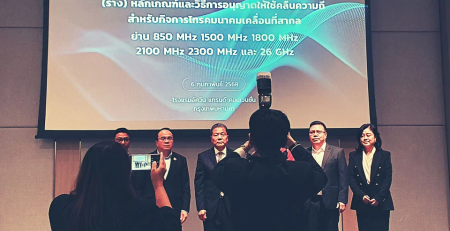
Thailand’s spectrum auction faces backlash for seemingly prioritizing the duopoly
Far from a competitive bidding war and pricing that would have maximized public revenue, the auction have served exactly as critics feared: a cost-saving exercise for Thailand’s dominant telecom duopoly, Advanced Info Service (AIS) and True Corporation (TRUE).
For months leading up to the auction, consumer advocacy groups, politicians, academics, and industry observers had sounded the alarm. They argued that the auction’s design would lead to a pre-determined outcome, solidifying the market duopoly and depriving the public of the true value of its national resources for the next 15 years.
On Sunday, June 29, their predictions came true (no phun intended).
Prices Settle Near the Floor in a Swift Process
The bidding process, which largely concluded within about one hour and in minimal bidding rounds, saw prices for key spectrum bands end just a fraction above the minimum starting prices.
AIS’ winning bid for the 2100MHz spectrum was only 10% higher than the reserve price, while TRUE’s 2300MHz bid was roughly 20% higher.
These modest increases stand in stark contrast to the aggressive bidding seen in previous auctions, as well as compared to the market expectation of 20–45%.
Adding to the impression of a pre-ordained outcome, it was widely foreseen that AIS would pursue the 2100MHz and TRUE the 2300MHz. Both operators already have radio access networks operating on these spectra as part of their previous contracts with the state enterprise telco, National Telecom (NT).
This existing infrastructure allows both companies to swiftly commence services on their newly acquired spectrum, providing them with gigantic savings compared to a fresh network rollout.
“If the final auction prices are not 10% greater than the floor price, there could be public concern over possible collusion,” warned ICT lawyer Paiboon Amornpinyokeat ahead of the auction. While the NBTC has the authority to scrap the results if it finds evidence of collusion, the bidding’s swift and low-cost conclusion has done little to dispel these concerns.
Billions in Savings for the Duopoly - Public Loses
For AIS and TRUE, the auction wasn’t a cost but a cost-saving opportunity. As reported by multiple securities firms, both companies stand to save billions of baht annually by transitioning from leasing spectrum from state-owned National Telecom (NT) to owning their licenses.
AIS is set to save over 2.9 billion baht (USD 89.13M) per year, while TRUE is expected to save 4.5 billion baht (USD138,3M) annually.
This shift further diminishes direct state income, as NT will no longer receive these substantial annual leasing fees from the major operators, compounding the effect of the relatively low auction prices.
This significant reduction in operational expenses is seen as a direct transfer of value from a public asset into corporate profits. While analysts are hailing these savings as a boon for shareholders and a driver of increased stock value, critics question whether the public, who are the ultimate owners of the spectrum, received a fair deal.
NBTC Commissioner Dr. Pirongrong Ramasut highlighted this concern before and after the auction, noting that if the starting prices had been aligned with what was previously paid to NT, the state could have generated 2.5 times more income from AIS’ winning bids and 2.3 times more from TRUE’s.
The starting price for this auction was flawed by being set at the same level as the 2012 3G auction. This decision ignored the decreasing value of money over time; 4.5 billion baht 13 years ago should equate to approximately 5.5 billion baht today. Furthermore, the 2012 starting price itself was already reduced by 30% from its appropriate value. Consequently, the current auction began with a price significantly lower than it should have been.
“This inappropriate pricing has cost the government over 70 billion baht (USD 2.15 billion) in lost revenue,” stated Dr. Prawit Leesathapornwong, former NBTC commissioner.
The NBTC board is set to hold a crucial meeting on July 2, 2025, to formally approve the auction results, but rumors suggest the vote may not be unanimous. Some board members reportedly harbor significant doubts that the auction was not genuinely competitive and that the spectrum was too clearly divided between the two dominant players.
Update: 02-07-2025 – The NBTC board today voted unanimously 7:0 to NOT approve the results of the spectrum auction, citing incomplete documents on the price collusion issue. Another special meeting will be held on July 6.
Update 04-07-2025 – Supinya Klangnarong, Chairwoman of the Subcommittee on Communications, Telecommunications, and Information Technology of the Consumer Council in Thailand, is calling on the NBTC to stop rushing to approve the spectrum auction resolution, while there are still lingering questions such as whether MVNOs will disappear.
Concurrently, questions have been raised about the initially low starting prices and public discontent. These internal doubts are further amplified by the large public outcry, including a protest staged at the NBTC office entrance on the auction day itself, directly challenging the fairness and transparency of the process.
It is also noteworthy that while the Administrative Court recently refused an emergency injunction to halt the current auction, it has accepted a lawsuit from consumer advocates challenging the auction’s legality and its potential impact on consumer interests, indicating ongoing legal scrutiny.
The Price of a Duopoly: Weakened Oversight and Dead MVNOs
The auction’s outcome does more than just boost corporate balance sheets; it entrenches the duopoly that has been the subject of intense scrutiny following recent mergers.
With only two qualified bidders participating, the auction was essentially a non-competitive allocation of a valuable national resource. Dr. Pirongrong herself observed that the auction results were “not different from what I had expected, that is, there was low competition, even in waves where more than one party had applied.”
The auction’s easy conclusion further reduces the likelihood of new entrants, such as Mobile Virtual Network Operators (MVNO), gaining a foothold.
Critics have long accused the NBTC for neglect of duty, failing to enforce their own regulations for more than a decade which would ensure network access for MVNOs, a failure that directly impacted businesses that had invested in the Thai market.
The auction of NT’s spectrum has diminish its capacity to just 5MHz bandwidth on 700MHz, leaving the MVNOs it supported no viable options, as it effectively forced them to rely on the dominant players. This is particularly concerning as critics point out that these major operators have historically failed to meet license conditions since 2013, which mandated providing at least 10% of their network capacity to MVNAs/MVNOs.
Despite the 10% capacity allocation for MVNOs being listed again among the general licensing conditions for this very auction, the NBTC has a documented history of failing to enforce such requirements, making the condition a joke.
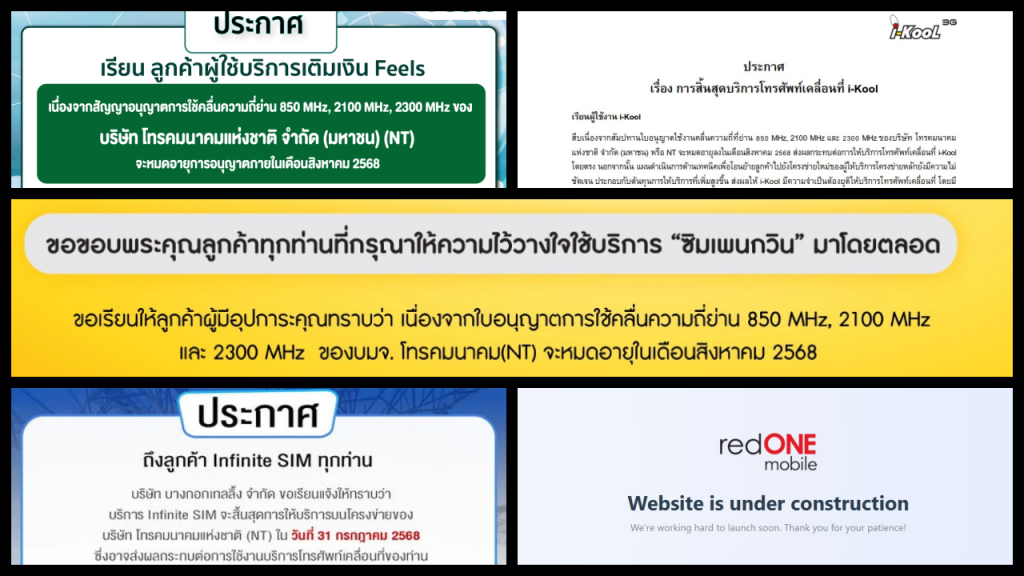
Even the four MVNOs left in Thailand saw this coming. Loxley (iKool) and Whitespace (Penguin SIM) announced their closure before the auction. Feels Telecom announce end of service on NT and that people can port their numbers, while the MVNO Redone is showing “Under Construction”. The latter has been “in talks” with TRUE since last year but nothing has so far materialized from that.
Compounding this issue, as part of the conditions set for the TRUE-DTAC merger more than two years ago, TRUE was explicitly required to open its network for MVNAs/MVNOs. Yet, despite these explicit merger conditions, nothing has materialized, and the NBTC has taken no action to enforce them. It has not even designated the two as Significant Market Powers (SMP).
The NBTC’s handling of the TRUE-DTAC merger is currently subject to a lawsuit at the Administrative Court, initiated by consumer groups, with the Supreme Administrative Court having ruled that such cases directly affecting public interest should be heard.
NBTC's Legacy: A Bottleneck for Thailand's Digital Transformation
In the end, NBTC’s latest spectrum auction is less of a success for the nation and more of a victory lap for the duopoly it has cemented.
This deeply entrenched two-player market, characterized by minimal competitive pressure and lack of regulatory oversight, threatens far more than just monthly phone bills. It transforms the foundational infrastructure of Thailand’s digital economy into a bottleneck controlled by two gatekeepers.
For consumers, this translates into a sustained risk of higher prices, reduced service innovation, and diminished quality, as seen in recent network outages.
For enterprises and the nation’s broader digital transformation goals – from smart agriculture to Industry 4.0 – this duopoly presents a significant impediment.
Real innovation and widespread digital adoption depend on a vibrant, competitive telecommunications sector, not one where the market is dictated by the comfort of two dominant players and the apparent reluctance of the regulator to enforce its own rules.
Without urgent and decisive action to foster genuine competition, Thailand risks falling behind in the global digital race, with its economic future held hostage by a market structure that prioritizes corporate profits over public prosperity.