NBTC Approves Its Own Auction Amid Legal Challenges & MVNO Crisis
This is custom heading element
NBTC approves AIS and TRUE as auction winners, but legal challenge still looms.
As expected, the National Broadcasting and Telecommunications Commission (NBTC) in Thailand has officially approved their own auction… with Advanced Wireless Network Co., Ltd., a subsidiary of Advanced Info Service (AIS), and True Move H Universal Communication Co., Ltd., a subsidiary of TRUE Corporation, as the winners of last month’s spectrum auction.
The decision, which confirms the total sale of just ฿41 billion ($1.266 billion USD) for 1500, 2100 and 23000MHz licenses, was made during a special meeting on Sunday after a three-hour debate.
However, despite the NBTC’s approval, the auction’s validity remains under scrutiny due to an ongoing legal challenge.
Legal Cloud Over Auction Outcome
More importantly than the NBTC’s internal approval, the Central Administrative Court has accepted a lawsuit filed by the Thailand Consumer Council and other consumer organizations.
This lawsuit seeks to revoke the NBTC’s auction announcement and criteria. The petitioners argue that the auction conditions did not adequately promote fair competition or allow for the entry of new market players, potentially solidifying the duopolistic market dominated by AIS and TRUE
Professor Pirongrong Ramasoota, an NBTC commissioner who voted against the approval, has openly shared her concerns about the auction process, highlighting issues regarding the low bidding prices and conditions that may favor the incumbent operators.
E.g. the inclusion of specific network rollout obligations in the 2100 MHz and 2300 MHz bands. The NBTC’s resolution mandates that the licensees must establish networks covering not less than 90% of the population in each sub-district within five years.
Such conditions are significantly easier for AIS and TRUE to fulfill. Both operators already have extensive network presence on the 2100 MHz and 2300 MHz spectrum, having provided services on these specific bands through their previous partnership with National Telecom (NT).
This pre-existing infrastructure means they are largely expanding or upgrading, rather than initiating, their network presence on these frequencies. For a new market entrant, meeting such rollout targets would require immense capital expenditure and time frame to build a network from scratch, effectively acting as a substantial barrier to entry.
Prof. Pirongrong also pointed out a significant change in the 2025 auction announcement: it originally omitted the standard daily fine clause for failing to meet rollout obligations.
All previous NBTC auction announcements since 2012 had included a daily fine of 0.05% of the highest auction price for non-compliance.
While the NBTC, by consensus (including her push), later agreed to re-add this penalty clause as an attachment to the license to protect consumer access, its initial omission further fueled suspicions that the terms were tailored to favor existing players.
Notably, the 1500 MHz band, which TRUE also acquired, does not carry the same rollout terms, and it has historically been designated for non-commercial use, further highlighting how the conditions for the commercially critical bands might have been tailored to benefit the incumbent operators.
Staggering Undervaluation: Billions in Lost State Revenue
Furthermore, given the low competition observed in the auction (where only two operators bid), the starting prices should have been set significantly higher to generate more revenue for the state.
Concerns about the auction’s fairness extend significantly to the pricing strategy, particularly for the 2100 MHz and 2300 MHz bands. Dr. Prawit Leesathapornwong, a former NBTC commissioner, has been a vocal critic, openly stating that the latest auction “reflects a fragile and utterly uncompetitive structure of the Thai telecommunications market.”
He views the handling of public spectrum resources as a “failure in policy, law, and management,” seeing them as tools for capital groups to monopolize rather than serve public interest.
Dr. Prawit highlighted that the low competition was predictable given only two mobile operators and a spectrum supply that arguably exceeded demand, leading to a “glut of spectrum.”
He offered scathing critiques on the reserve prices set by the NBTC:
2100 MHz (3 sets acquired by AIS for THB 14.85 billion total): Dr. Prawit stated that while the NBTC set the starting price at THB 4.5 billion per set, the market value (based on NT’s previous annual leasing rate of THB 3.9 billion per set for 15 years, discounted) should be approximately THB 12 billion per set. This means the reserve price was significantly below market value.
He further stressed that the 4.5 billion starting price was the same as that used in the 2012 3G auction. He argued that this approach is flawed, as the value of money has decreased over time (4.5 billion in 2012 should be around 5.5 billion today).
Moreover, the 2012 starting price itself was reportedly 30% lower than it should have been, leading to a compounded undervaluation.
2300 MHz (7 sets acquired by TRUE for THB 21.77 billion total): For this band, acquired by TRUE, the starting price was THB 2.5 billion per set. Dr. Prawit contended that its market value (based on NT’s previous annual leasing rate of 4.5 billion per set for 15 years, discounted) should be approximately 7.3 billion per set.
This implies the NBTC’s starting price was about 65% lower than its current market value.
Dr. Prawit asserted that “this inappropriate pricing will cost the state over THB 70 billion in lost revenue, while allowing private companies to significantly reduce their operational costs, without benefiting consumers in return.”
Adding to concerns about pricing, Dr. Prawit also criticized the “holding fees” bid for choosing frequency blocks. He noted that one operator offered a mere THB 10 for the 2100 MHz block selection, and the other bid only THB 168 for the 2300 MHz and 1500 MHz selections, which he deemed “highly unreasonable” given the immense value of these bands and the cost of organizing the auction. The lack of a minimum price for block selection, he said, clearly demonstrates a “cushioning” of the private operators.
The Collapse of Thailand's MVNO Sector
Concurrent with the auction, Thailand’s MVNO sector has collapsed, with its remaining players either defunct or on the precipice of extinction.
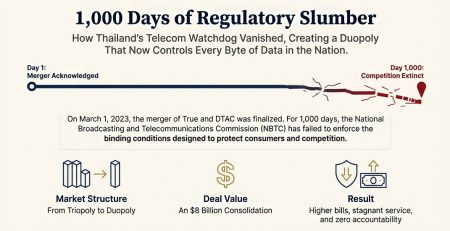
The auction of National Telecom’s (NT) spectrum, which was the only one to host MVNOs, has acted as a “final nail in the coffin,” effectively herding these operators towards AIS and the merged TRUE/DTAC that have historically proven unwilling to provide mandated wholesale access.
This crisis is attributed to the NBTC’s decade-long regulatory inaction, specifically its failure to enforce its own regulation mandating AIS and TRUE to provide at least 10% of their network capacity to MVNA/MVNOs.
Despite the 10% capacity allocation being cynically re-listed in the new auction’s conditions, NBTC’s neglect of Duty to enforce it has led to a whole business sector ceasing operations, representing squandered local and foreign investments, prompting calls from consumer groups, politicians and the public for the NBTC to halt approval and address these profound issues.
While the Administrative Court initially refused an emergency hearing to halt the auction (allowing it to proceed as scheduled), its decision to accept the lawsuit for full consideration indicates that the court finds valid grounds for a legal review of the auction’s legality and its potential impact on consumer interests. The outcome of this court case could ultimately affect the long-term validity or conditions of the licenses awarded to AIS and TRUE.
Commissioners Decision
The NBTC’s endorsement followed a delay from an earlier scheduled session on Wednesday, July 2, 2025, highlighting the significance and complexity of the discussions surrounding the auction results. Only two operators participated in the auction, making the outcome anticipated by industry observers.
The seven commissioners engaged in an “intense discussion” before reaching their final vote. The outcome saw a 5–1–1 split among the commissioners. Five members voted in favor of approving the results:
- Dr. Sarana Boonbaichaiyaprueck (Chairman)
- Air Marshal Thanapant Raicharoen
- Torpong Selanon
- Pol. Gen. Nathathorn Prousoontorn
- Sompop Purivigraipong
While the majority approved the results, there were dissenting voices. Assoc. Prof. Dr. Suphat Suphachalasai who had also voiced concerns before the action, abstained from the vote, and Prof. Pirongrong Ramasoota voted against the endorsement, actively detailing her concerns.
This official endorsement from the NBTC, while a crucial step for AIS and TRUE, is now overshadowed by the pending court decision and the detailed concerns raised by high-profile commissioners. The telecommunications landscape in Thailand will undoubtedly remain a subject of close observation as the legal proceedings unfold.
NBTC's Shortcomings Cloud Thailand's OECD Membership Bid
It’s going to be a significant challenge for Thailand to secure OECD membership, with a regulator like the NBTC failing to live up to OECD’s essential guidelines on good regulatory practice.
Thailand is actively pursuing membership in the OECD, with the accession process officially launched in October 2024. This involves a rigorous and in-depth evaluation by 26 technical committees of Thailand’s alignment with OECD standards, policies, and practices across various public policy areas, including governance, integrity, and regulatory frameworks.
For Thailand to fully align with OECD guidelines on good regulatory practice, especially in the telecommunications sector, the NBTC would need to demonstrate a consistent adherence to principles like:
Regulatory Independence and Accountability: Regulators should operate with sufficient independence from political influence while remaining accountable for their actions and outcomes.
Transparency and Predictability: Clear, consistent, and predictable regulatory frameworks are crucial for attracting investment and fostering competition.
Evidence-Based Decision-Making: Regulatory decisions should be grounded in sound analysis of costs, benefits, and risks, including thorough Regulatory Impact Assessments (RIAs).
Stakeholder Engagement: Effective consultation with businesses, consumers, and other relevant parties throughout the regulatory lifecycle is essential.
Ex-post Evaluation: Regularly assessing whether regulations are achieving their intended goals and making necessary adjustments is a key aspect of good regulatory practice.
Failure to Enforce MVNO Regulations, Exacerbated by Recent Auction: A clear illustration of the NBTC’s regulatory shortcomings lies in its handling of the Mobile Virtual Network Operator (MVNO) market. Despite the issuance of numerous MVNO licenses, a significant number of these ventures have failed to launch or thrive due to the NBTC’s inability to effectively enforce regulations that ensure fair wholesale access to incumbent mobile network operators (MNOs).
This lack of robust enforcement stifles competition, innovation, and consumer choice, directly contravening OECD principles regarding market openness and effective competition. The situation has led to accusations of regulatory oversight and a struggle for MVNOs to secure equitable terms, raising serious questions about the NBTC’s capacity to create and maintain a truly competitive telecommunications landscape.
The OECD’s accession process serves as a catalyst for reform, and the technical reviews will specifically identify areas where Thailand’s legislation, policies, and practices, including those of the NBTC, need to be brought further into line with OECD standards.