The Private Network Sham: Factories Get Free 5G? No — Telcos Get a New Monopoly
Thailand’s 5G private network initiative: a controlled ecosystem that benefits a telecom duopoly, not industry innovation.
Presented as a bold step toward industrial innovation, an initiative by Thailand’s telecom paper tiger promises to empower enterprises with free private network spectrum.
While the NBTC paints a picture of open access, the framework’s fine print reveals a different story.
Beneath the surface lies a policy riddled with loopholes that in essence hands a lucrative B2B market to the telecom duopoly of Advanced Info Service (AIS) and True Corporation (TRUE), sidelining factories, smaller operators, and Thailand’s already beleaguered Mobile Virtual Network Operators (MVNOs), Mobile Virtual Network Aggregators (MVNAs), and Mobile Virtual Network Enablers (MVNEs).
This move is not an isolated misstep but part of a broader pattern of regulatory failure.
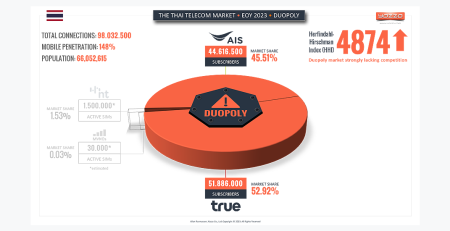
Thailand’s telecom market, dominated by the duopoly of AIS and TRUE post the TRUE-Dtac merger, controls 99.57% of all mobile connections in the country, and 82% of the fixed broadband internet market in Thailand.
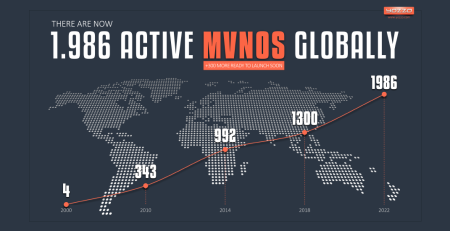
The NBTC has systematically stifled competition, particularly for MVNOs, which—despite over 65 MVNO licenses issued—have all but vanished by 2025 due to unenforced wholesale access rules and the expiration of National Telecom’s (NT) spectrum holdings.
MVNAs and MVNEs, licensed entities like MVNO.SERVICE Co., Ltd. that aggregate wholesale capacity and provide backend support, exist on paper but remain unmentioned and underutilized in the NBTC’s 4800MHz framework.
This omission reveals a deeper agenda: prioritizing the duopoly’s profits over genuine market diversity, even as MVNAs/MVNEs could theoretically bid as Private Network Operators (PNOs) to serve factories.
The Official Narrative: Innovation for All?
NBTC Commissioner Somphop Purivigraipong, overseeing the telecom sector, paints a rosy picture: The 4800MHz spectrum will be allocated for “non-profit use” to factories, industrial estates, and enterprises, with the explicit goal of “driving vertical industries to develop their 5G private networks for operations.”
Factories can apply regardless of whether they build the network themselves or “collaborate” with equipment vendors or telecom operators.
The band, ideal for localized, high-capacity 5G coverage, aims to address the stagnation in Thailand’s 5G adoption, where mass-market usage is largely limited to video streaming and complementing 4G service, with few factories leveraging the existing 26GHz band due to limited real-world use cases.
The NBTC initially considered the globally popular 3500MHz band for private networks but shifted to 4800MHz due to “technical issues” and objections from satellite TV broadcasters using the 3500-3800MHz range. Up to 700MHz of 3500MHz may still be allocated later, with auctions planned for late 2027.
The promise of 4800MHz is tantalizing: smart factories with automated assembly lines, predictive maintenance in petrochemical plants, or seamless logistics in ports.
Yet, this vision crumbles under scrutiny, as the policy’s structure ensures that factories—and Thailand’s telecom ecosystem, including licensed MVNAs and MVNEs—face insurmountable barriers.
The Hidden Handover: PNO Auctions and the Duopoly’s Backdoor
The cornerstone of this policy is the Private Network Operator (PNO) framework, a regulatory loophole that undermines the “free spectrum” promise.
Businesses aspiring to be PNOs can bid for rights to use the 4800MHz band to provide services to factories and industrial estates.
AIS and TRUE are explicitly allowed to participate, with only restrictions barring them from using the spectrum for mass-market mobile services or roaming it with their existing spectrum holdings.
These rules sound strict but are largely performative.
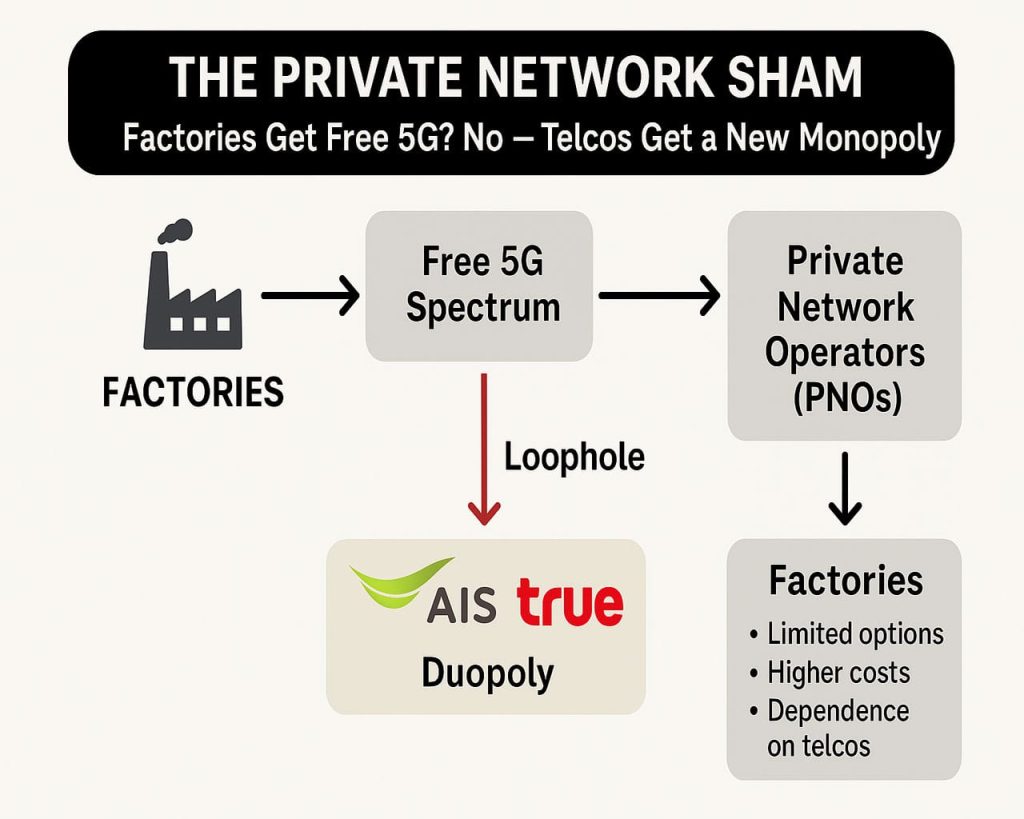
Deploying a 5G private network requires radio access, core networks, backhaul, cybersecurity, and ongoing maintenance—expertise and capital most factories lack.
But Mr. Somphop notes that, factories can “collaborate with equipment vendors or telecom companies” to deploy solutions. In practice, this invites AIS and TRUE, with their nationwide infrastructure and deep pockets, to dominate.
But what about MVNAs and MVNEs? Thailand’s Type 1 licenses allow these entities to aggregate wholesale capacity and enable virtual networks, positioning them ideally for PNOs and offer tailored, cost-effective private 5G services to factories without the duopoly’s baggage.
Yet, the NBTC’s announcement makes no mention of them at all, ignoring their potential to foster competition in the enterprise space.
MVNO.SERVICE Co., Ltd., a licensed MVNA/MVNE, could theoretically partner with factories to manage backend operations and spectrum access, but without explicit inclusion or support, they remain sidelined—victims of the same regulatory neglect that killed all MVNOs in Thailand.
The duopoly’s scale ensures they can outbid and outmaneuver any PNO hopefuls, including MVNAs/MVNEs. Factories, daunted by complexity, will lease managed services from AIS or TRUE, paying premiums for one-size-fits-all solutions.
The devil is in the details, as the “non-profit” clause only bars factories from reselling; it doesn’t limit the duopoly’s B2B profits. This setup creates a high-margin enterprise playground for AIS and TRUE, while MVNAs/MVNEs—meant to democratize access—are left out in the cold.
Echoes of the MVNO Fiasco: Competition Crushed, Again
This 4800MHz scheme doesn’t exist in a vacuum—it’s a sequel to the NBTC’s MVNO debacle.
Back in the early 2010s, the regulator promised MVNOs would democratize mobile services via Type 1 licenses, offering affordable alternatives to AIS, TRUE, and formerly Dtac.
Spectrum in consumer bands was auctioned to the three, leaving MVNOs dependent on wholesale access squeezed by the three’s refusal to provide wholesale access on their own spectrum.
The only access the MVNOs got was to the state-enterprise National Telecom’s (NT) spectrum, where the spectrum was controlled by the three under a partnership agreement with NT.
By 2025, the dream is dead: NT’s spectrum expiration in August 2025 terminated all MVNO services, with operators like Feels Telecom, Penguin SIM (Whitespace), i-Kool, and Infinite SIM announcing shutdowns due to failure in getting network access.
Despite mandates for 10% capacity reservation to MVNOs since 2013, the NBTC never enforced it over AIS and TRUE, allowing the duopoly to ignore “fair, reasonable, non-discriminatory” rules.
MVNAs and MVNEs, licensed to support the ecosystem (e.g., aggregating bulk deals or providing core elements), were equally overlooked.
The NBTC’s “One Region, One MVNO” push in 2024 aimed for regional entrants by 2026, promoting MVNA/MVNE platforms for 20% cheaper rates, fizzled amid duopoly resistance and NT’s collapse.
Now, in the private 5G arena, the same incoherence persists: MVNOs/MVNAs could pivot to PNOs for factories, but the policy’s silence on them ensures the duopoly’s dominance. Smaller players risk becoming subcontractors, while factories get “free” spectrum but no real choice.
Broader auctions loom—Q1 2025 for 850-2300 MHz to bolster 5G-Advanced—but without addressing the duopoly’s grip or empowering MVNAs/MVNEs, these will fatten AIS and TRUE further. The 2G/3G phase-out by 2026 only benefits the incumbents.
Who Wins, Who Loses—and Why It Matters
Winners: AIS and TRUE, unequivocally. This policy creates a fenced-off B2B revenue stream, diversifying their monopoly without consumer auction backlash.
The NBTC claims credit for “promoting real use cases for 5G private network adoption.”
Losers: Factories and industrial estates get spectrum but not independence, relying on duopoly services.
MVNOs are extinct; MVNAs/MVNEs, despite licenses, are invisible in this framework, unable to leverage PNO bids without NBTC support. SMEs and vendors face barriers, stifling innovation.
Thailand’s economy misses competitive efficiencies in manufacturing and logistics.
Politically, this aligns with cronyism: The NBTC, independent in name, bows to AIS and TRUE’s influence. To meet 5G targets (40% penetration by 2025), it chooses the easy path: Duopoly execution over diversity.
Compounding this is the fact that the major shareholders of AIS, primarily Gulf Energy Development, and TRUE, controlled by the Charoen Pokphand (CP) Group, are also deeply active in the very industries targeted by this private 5G initiative e.g.
- Energy Sector: Gulf’s gas-fired plants, renewables, and LNG; CP’s biomass via CP Foods.
- Agriculture: CP Foods
- Retail: CP All’s 7-Eleven and CP Axtra’s Makro/Lotus’s
- Electric vehicles: Gulf Energy’s EV infrastructure investments and CP Axtra’s EV fleets, and CP Group through its joint venture with SAIC Motor, the Chinese parent company of the MG brand.
This creates a blatant conflict of interest, as the duopoly can prioritize spectrum access and services for their affiliated businesses in these sectors, further entrenching their cross-industry dominance at the expense of independent factories and smaller operators.
Analysis
1. The “Hidden Way” to Give Spectrum to AIS and TRUE
While the NBTC’s plan sounds altruistic—”free spectrum for factories”—the reality of who can effectively utilize that opportunity is key.
- Technical and Financial Barriers: A factory, on its own, is unlikely to have the expertise, equipment, and capital to build and operate a standalone 5G private network. Deploying such a network involves not just a radio but also a core network, backhaul, and ongoing maintenance. This is where the major telcos, AIS and TRUE, have a massive advantage.
- The “Collaboration” Clause: The NBTC’s statement that factories can “collaborate with equipment vendors or telecom operators” is the loophole identified. It’s an invitation for the two dominant players to step in and provide the expertise and infrastructure that factories lack. This makes the “free” spectrum for factories a de facto managed service opportunity for the telcos.
- The PNO Auction: The plan to allow “businesses [that] might want to be private network operators (PNOs)” to bid for the right to use the band to serve their customers is another path for AIS and TRUE. They can simply bid for these PNO licenses and, with their existing infrastructure and market power, outcompete any new, smaller players. The “prohibition” on roaming with their mass-market service is a regulatory measure, but it doesn’t change the fact that they are best positioned to win these bids.
2. The “Non-Profit” Wording as Cover
The “non-profit use” for internal factory operations is a way to frame the allocation as a public benefit, not a commercial giveaway. However, the profit for the telcos doesn’t come from the factories’ internal use; it comes from the services and solutions they sell to the factories to enable that use.
- Service Revenue vs. Spectrum Revenue: The NBTC isn’t auctioning the spectrum to the factories, so the telcos don’t pay a huge upfront fee. Instead, the telcos will generate revenue from a new B2B vertical, providing an ongoing revenue stream for network deployment, management, and customization. This is a very different, and potentially more lucrative, business model than a one-time auction fee.
- Creating a New Monopoly: By setting the rules this way, the NBTC is effectively creating a new market—the private 5G market—but structuring it in a way that gives the existing duopoly the inside track. It’s a way to expand their business without the public scrutiny and competition that a traditional mass-market spectrum auction would entail.
3. The Political and Market Context
The understanding of the political landscape in Thailand is crucial for this interpretation. The NBTC is on paper an independent body, but it operates within a political and economic reality where AIS and TRUE are powerful entities.
- The Duopoly: After the TRUE-Dtac merger, AIS and TRUE dominate over 99% of the mobile market. The NBTC knows that giving them more mass-market spectrum would face public backlash and raise serious competition concerns.
- The Need for a “Justification”: The NBTC needs a public-interest justification for any new spectrum allocation. “Promoting 5G private networks for industry innovation” is a perfect narrative. It addresses the perceived stagnation of 5G in Thailand and aligns with national goals for industrial development.
Conclusion
The public-facing narrative focuses on innovation and “free” spectrum for factories, but the specific details of the plan—the allowance for collaboration, the PNO auctions, and the inherent technical barriers for smaller players—all point to a system that is designed to benefit the two major players who have the resources to capitalize on it.
This isn’t about free spectrum for factories. It’s about gifting AIS and TRUE a new, fenced-off B2B playground.
The Viable Solution: A National Wholesale Network
The NBTC’s 4800MHz allocation is regulatory theatre—promising empowerment while engineering dominance.
Instead of the NBTC handing the 4800MHz spectrum to the duopoly via PNO auctions, this spectrum—along with commercial bands—should be allocated to National Telecom (NT) to manage.
NT, as a neutral state-owned entity, would then establish a National Wholesale Network (NWN). This wholesale-only network would serve as a backbone, providing 4G/5G access and support to a diverse range of MVNOs, enterprises, and communities.
See more here: Research Report: A National Telecom Wholesale Network
By operating under this model, NT would not compete at the retail level but would enable competition by providing fair, open, and non-discriminatory access to the spectrum. An MVNA/MVNE would manage this process, selling wholesale access to the NWN to various players, thereby democratizing access to 5G capabilities for a wide range of industries and users.
This model fosters an ecosystem that benefits all stakeholders:
- NT can fully utilize and monetize new spectrum bands while generating a new wholesale revenue stream.
- MVNAs/MVNEs are incentivized to support MVNOs, as their own business success is directly tied to the growth of the virtual operators.
- MVNOs get fair and transparent network access, allowing them to provide tailored, innovative services to niche markets under their own brand and pricing.
- Enterprises gain the ability to build and operate their own mobile services, using the data to drive their digital transformation without being locked into the duopoly.
- Consumers benefit from increased competition, a wider range of services, and more affordable prices.
- Thailand benefits from increased digital inclusion, sustainable use of public assets, and economic growth.
The NWN model ensures competition at the service level, where MVNOs can innovate, rather than at the network level, which is capital-intensive and subject to duopoly control.
Thailand deserves 5G that innovates for all, not just the elite two.