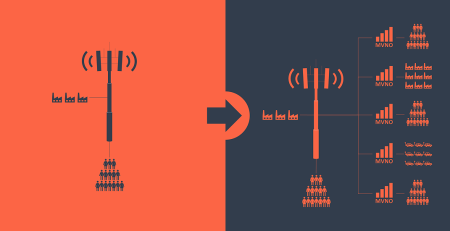
Full MVNO
This is custom heading element
The full MVNO is responsible for the whole operation, customers, and data—giving it full control over all the services and products it offers in the market, as well as flexibility in designing and deploying new services, either to end-users or for Internet of Things (IoT) / Machine-to-Machine (M2M). The mobile network operator (MNO) supplies the network access.
The Full MVNO has a switching and transmission infrastructure, allowing the management of its traffic. It can administer numbering resources, customer service, VAS, roaming, SIM and device management, and other services required for the provision of mobile services. This type of integration allows greater flexibility when using the capacity and services of mobile network operators.
The Full MVNO operates (technically, not business-wise) in a similar way to a mobile network operator, but without a spectrum and radio access network (RAN), which it still leases access to from its HNO.
The amount of control and ownership over its business, its positioning, branding, marketing, and the relationship a MVNO establishes and builds with its host operator are key factors for MVNO success.
A Full MVNO delivers longer-term value to the host network operator.
Full MVNO Model - Advantages
- Its own SIM cards
- Own numbering ranges
- Home Location Register (HLR)
- Gateway GPRS Support Node (GGSN)
- Short Message Service Centre (SMSC)
- Multimedia Messaging Service (MMSC)
- Gateway Mobile Switching Centre (GMSC)
- Own roaming and interconnect agreements
- Owning the network-switching infrastructure
- Set tariff bundles and packages independently
- Complete customer ownership and relationship
- Focus on addressing a particular niche or segment
- Upsell own or partner services as value-added services (VAS)
- Access to big data (user usage data) to better address the needs and wants
- Use the MVNO to capture a share in the mobile market and generate telecoms revenues
- Uplift to an existing core business (bundles) and obtain more control and independency from telcos.
Full MVNO Model - Disadvantage
- Heavy cost on OPEX and CAPEX associated with the needed IT platforms.
- Needs a certain level of telecom know-how and understanding.
Full MVNO Model - Operational Model / MVNO Architecture
- Responsible for all the whole infrastructure and value chain – except network radio and spectrum
Table: Example of Elements, Functions and their advantage to the Full MVNO
| Elements | Function | Advantages |
|---|---|---|
| MSC Mobile Switching Center |
|
|
| SGSN Serving GPRS Support Node |
|
|
| GGSN Gateway GPRS Support Node |
|
|
| HLR Home Location Register |
|
|
| 5GC/UPF 5G Core / User Plane Function |
|
|
| PCRF Policy and Charging Rules Function |
|
|
| UDM User Data Management |
|
|
| OSS/BSS Operations & Business Support Systems |
|
|
| SMSC/MMSC Short/Multimedia Message Service Center |
|
|
In a Full MVNO stack integration example, the Full MVNO will install Business and Operations Support Systems (BSS/OSS) and Core Elements such as:
- IN (SCP)
- STP/DSC
- HLR/HSS
- SBC
- SMSC/SMS-G
- IVR/VMS
- OSS/BSS
- OCS
- GGSN/PGW
- USSDGW
The host network operator (HNO) is responsible for providing the following network elements:
- Radio Access Network
- MME / SGW / SGSN / GGSN / PGW / PCRF
- MSC / VLR / STP / EIR
- EIR (MNO / MVNO)
- SBC / GMSC
- DRA (DSC)
- Internet (ISP)
- DNS
- Public IPs and NAT
Full MVNO Model - Business Model
- Revenues: from traffic of its own customers and revenues from incoming traffic (Off Net)
- Costs: Wholesale rates, marketing, sales, distribution, OPEX and CAPEX associated to the IT platforms.
- Wholesale rates may vary with the type of Voice/Data/SMS/MMS, e.g., On-Net or Off-Net, National or International (origin/destination).
The Full MVNO can:
- Have their own roaming and interconnect agreements with other mobile network operators.
- Gain deep insights into customer or machine (M2M/IoT) profile.
- Create “stickiness” with customers, where the customer will be under greater control of the MVNO.
- Offer a convergence proposition, where the technical integration is important.
Operating as a Full MVNO provides the MVNO the opportunity to increase its focus on differentiation, segmentation, and customer loyalty.
Full MVNO Model - Regulation
Examples of regulatory decisions and documents regarding “FULL MVNO”
The regulatory approach towards MVNOs differs across markets depending on how open it is to network access. The level of intervention varies from heavy-handed market interference to purely commercial negotiation and creating a more favorable entry setting.
EU/EEA
Full MVNO access is mandated by some of the National Regulatory Authorities in EU/EEA member states, with a strong focus placed on the ability for Full MVNOs to be able to:
- Switch between Host MNO networks,
- Rely on multiple host MNOs in parallel,
- Have full commercial autonomy on all retail markets and distribution networks, and;
- Own their customer base, and not be subject to restrictions on changes in their shareholding structure, or selling the wholesale access rights they contractually acquired. In addition, the MNO license conditions provide for;
- Technical non-discrimination in favor of MVNOs on quality of service (QoS), compared to the Host MNO’s own services,
- An explicit right for the Full MVNO to own and operate its own core network and its own interconnections with third party operators, and,
- Reasonable economic conditions, compatible with effective and loyal competition on wholesale and retail markets.
Singapore
The Info-communications Development Authority (IDA) of Singapore: “Framework for the allocation of spectrum for international mobile telecommunications (“IMT”) and IMT-advanced services, for the enhancement of competition in the mobile market”. (“the IDA Decision”).
India
The Department of Telecom (DoT) in India, states in its guidelines for MVNO License”, that the MVNOs are free to choose its business model (Full or Intermediate or Thin).
https://trai.gov.in/sites/default/files/recom6aug08.pdf
Iran
Iran’s Communications Regulatory Authority (CRA) has two types of MVNOs: Light and Full MVNO
Canada
Canadian Radio-television and Telecommunications Commission’s registration requirements for a full MVNO
Within 12 months of being registered as a proposed full MVNO the entity must clearly demonstrate to the Commission that it has met the requirements to be registered as a full MVNO as per the International Mobile Subscriber Identity (IMSI) Guideline. According to the IMSI Guideline, a full MVNO is an entity that meets these eligibility requirements:
A. Clearly demonstrates in writing that it meets the technical criteria of a full MVNO. This includes providing a network diagram and description that demonstrates that it: i. owns and operates core network hardware separate from all wireless service providers (WSPs); ii. has a service profile management system (SPMS) for end-user devices that can access WSP networks in Canada
The descriptions should include how the entity’s network operates and how it accesses its host wireless carrier’s network.
B. Identifies the wireless carrier with whom the entity has a wholesale full MVNO access agreement. The entity must provide a contact name of an individual at its host wireless carrier who can address questions regarding the technical nature of the wholesale full MVNO access agreement.
In order to ensure that Commission staff has sufficient time to review a request to be registered as a full MVNO and determine that the criteria have been met, entities should, two weeks before the registration expiry date, submit the above information and any information it deems relevant to its application, by a letter addressed to the Secretary General.
Footnote 1: The entity must submit a letter to the Commission that (i) provides the details on how the entity meets the full MVNO requirements, and (ii) identifies the wireless carrier with whom it has a wholesale full MVNO access agreement.
Additional MVNO Type & Operational Models Information
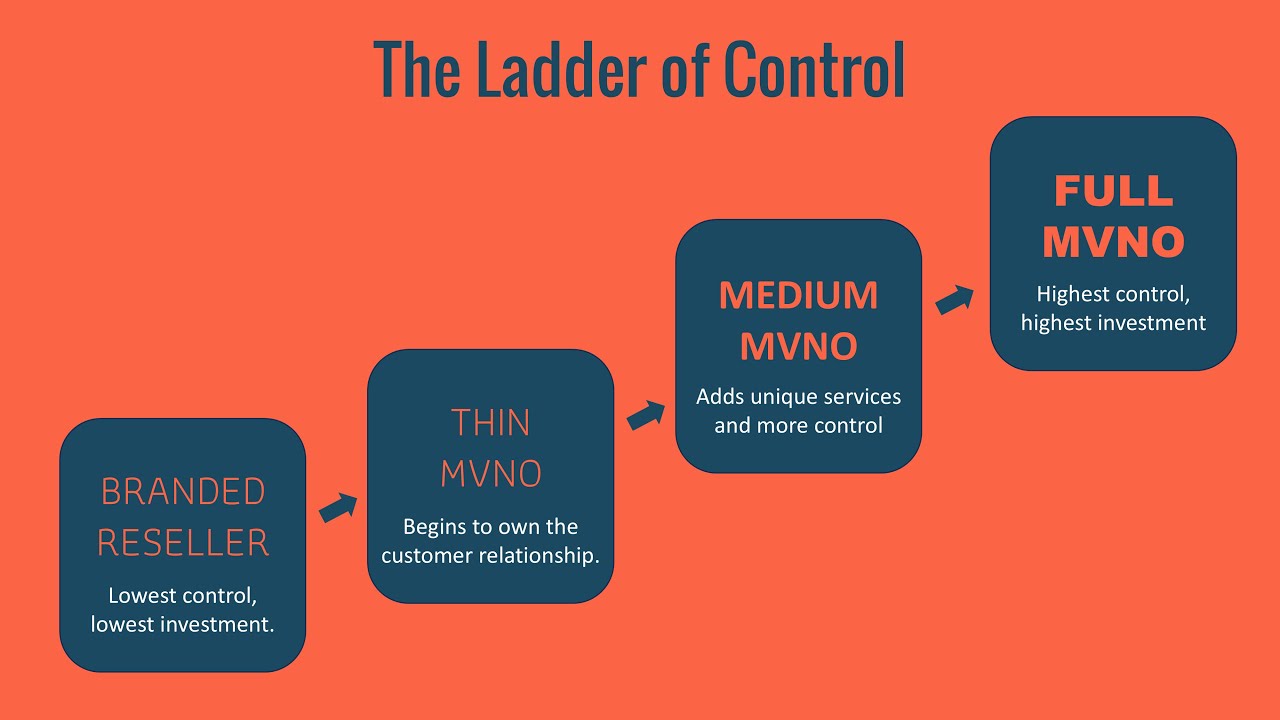
For a visual deep-dive, watch our video on Thin • Medium • Full – MVNO Types and Operational Models.
Check out our podcast: “Enabling MVNO Success: A Guide to MVNE” – on Spotify or SoundCloud