
MVNO Types & Operational Models
This is custom heading element

What are the types of MVNO models – and why is it important? MVNO types are defined by which of the operational components the MVNO manages and which one the host network operator manages – indicating the depth of the individual MVNO’s market participation.
Mobile Virtual Network Operators (MVNO), are companies that provide mobile phone services but do not own the wireless network infrastructure over which they operate. Instead, they lease network capacity at wholesale rates from a Mobile Network Operator (MNO) and sell it to their customers.
While all MVNOs follow this core business model, they aren’t all the same. The various types of MVNOs are defined by a crucial factor: the degree of control they have over their operational components. This ranges from simply reselling airtime to managing their own core network.
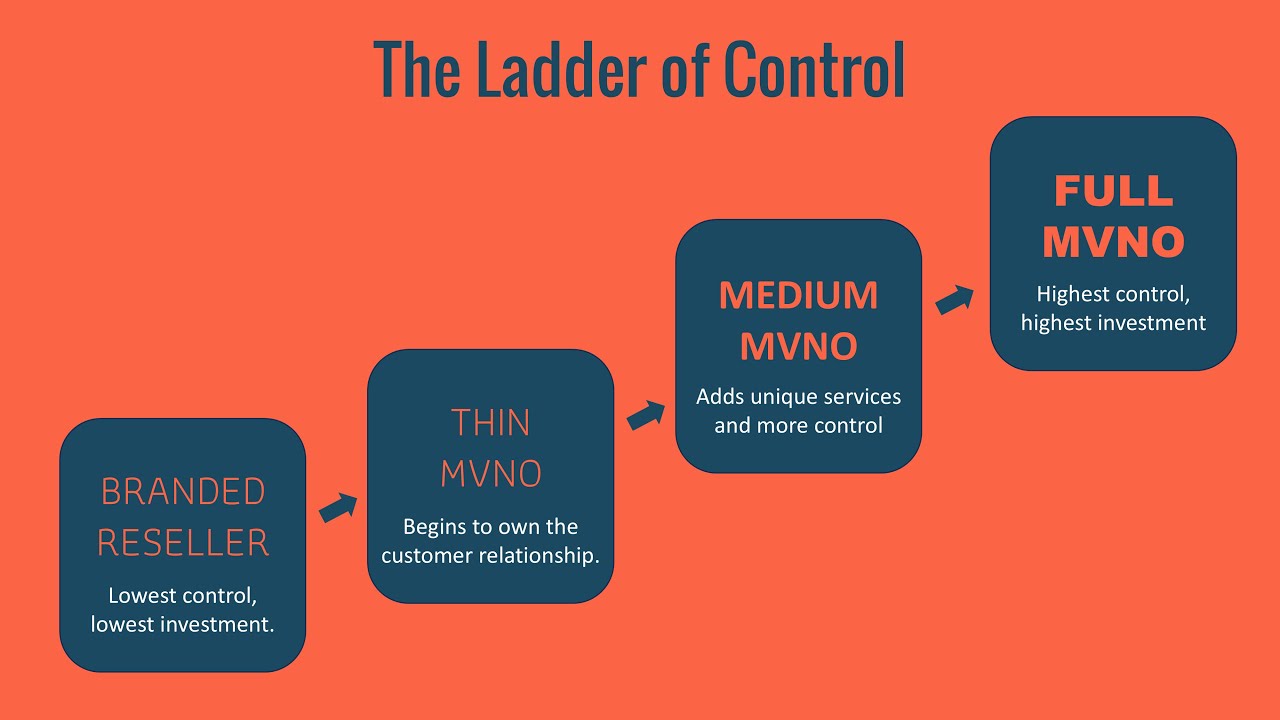
The Ladder of Control
If you ever tried to figure this out, you may have come across this wall of jargon: Airtime Reseller, Basic MVNO, Branded Reseller, Digital virtual network operators (DVNOs), Enhanced Service Provider (ESP), Extended MVNO, IMSI MVNO, Full MVNO, Hybrid MVNO, IN MVNO, Medium MVNO, On-brand MVNO, Reseller MVNO, Service Provider MVNO, Thick MVNO, Thin MVNO, etc. – it is an absolute alphabet soup.
However, we can boil all that complexity down to just four simple steps up a ladder, and use the most common terms for the type of MVNO:
For a visual deep-dive, watch our video on Thin • Medium • Full – MVNO Types and Operational Models.
Hi, and welcome to Yozzo’s podcast dedicated to empowering mobile virtual network operators with the insights they need to succeed.
This is the place where we break down the complexities of the MVNO ecosystem.
Let’s get started.
So, if you’ve ever used one of those smaller, maybe more niche mobile carriers, you’ve actually been a customer of an MVNO.
That’s a mobile virtual network operator. Now, these are the companies that sell you mobile service, but here’s the kicker. They don’t own a single cell tower. So, how on earth do they do that?
Well, that’s what we’re going to break down.
And you know, if you’ve ever tried to figure this stuff out on your own, you get hit with this just this wall of jargon, right?
Airtime reseller, thick MVNO, thin MVNO, enhanced service provider. It’s an absolute alphabet soup. And honestly, it makes it feel impossible to figure out who’s who and what’s what.
But what if you could boil all that complexity down? What if it was really just four simple steps up a ladder?
That’s exactly what we’re going to do. We’re going to cut through all that noise and give you one simple framework to see how a company goes from just being a brand to a real honest to goodness mobile operator.
And here it is. We’re calling it the ladder of control. It’s pretty straightforward. We’re going to start at the bottom on the first rung with the basic reseller and we’re going to climb all the way to the top to the full MVNO.
And as you’ll see, every step up that ladder means more money. Yeah. But it also means way more control. All right, so let’s get started.
We’re on the very first rung of the ladder, the reseller MVNO. Think of this as the easiest, most common way for a new brand to dip its toes in the mobile world.
A reseller, well, it’s pretty much exactly what it sounds like. Their whole job is to focus on the flashy stuff, the branding, the marketing, the sales. They bring the customers in the door, but everything else, all the technical stuff, the heavy lifting, that’s all handled by the big guy, the host network, what we call the MNO or mobile network operator. So, you can see the appeal, right?
The huge advantage here is that it’s super cheap and incredibly fast to get started. You can launch a mobile brand almost overnight. But, and this is a big butt, the downside is massive. You have basically zero control. The host network owns your customer. They own the SIM card. They own all the user data, and they set the prices. You’re really just a sales front.
I mean, just look at how this breaks down. The reseller, their only job is marketing and sales. That’s it. Everything else you’d associate with a mobile company, billing, customer service, the actual SIM cards, the network itself, that’s all on the host MNO.
It’s a partnership for sure, but it’s a very, very one-sided one.
Okay, time to climb a little higher. We’re moving up to the middle rungs of the ladder. Now, this is where things get interesting. Companies start taking on more responsibility, a little more risk, but in return, they get a whole lot more say in their own future.
We’re talking about thin and medium MVNOs now. And this is where a brand starts to get really serious. You’re not just a sales agent anymore. Now you actually start to own the relationship with your customer.
You manage your own billing and you can even start creating your own unique services that make you stand out from the crowd. And the key word here is control. The MVNO now runs its own CRM. That’s the customer relationship management system. They have their own BSS or billing support system. Having that control is a gamechanger. It means they can set their own prices, create their own data bundles, and maybe most importantly issue their own branded SIM cards.
That’s a huge leap from being a simple reseller. But you know how it goes. With more control comes more responsibility and more cost. The upside is fantastic. You finally own your own customers.
You can build a real brand for a specific community. The downside though, your IT cost just shot way up, both for day-to-day operations and initial investment. And at the end of the day, you’re still relying on the big M for the actual network connection. All right, we’ve climbed all the way to the top. This is the final rung on the ladder.
We’re talking about the full MVNO, the most powerful, most independent a virtual operator can possibly be. Here’s the easiest way to picture this. A full MVNO is basically a traditional mobile network in every single way except one. They don’t own the radio towers. That’s it. They lease access to the towers, but pretty much everything else they own and operate it themselves.
And the perks of being at the top, they are huge. We’re talking complete ownership of the customer, your own blocks of phone numbers, and your own network switching gear. That last one is key.
It means you can negotiate your own roaming deals with other carriers. You get total flexibility and direct access to all that rich, valuable user data. I mean, the technical complexity here is just on another level.
A full MVNO might own and operate more than 15 separate pieces of the core network. all those complicated bits and pieces that make a mobile service actually work.
So, let’s just zoom in on two of the most important ones to really get what that control means. First up, you have the HLR, the home location register. Think of this as the master brain, the central database that keeps track of every single one of your subscribers.
When you own the HLR, you control your own SIM cards and you get to decide exactly what services each customer can access. Another critical piece of the puzzle is the GGSN. Okay, that’s a mouthful, but it’s basically the gateway to the internet for your customers.
It’s the on-ramp. And if you own that gateway, you can see, manage, and control all the data your customers are using. And in today’s world, that is an absolutely critical power to have.
Okay, so we’ve climbed the whole ladder from bottom to top. But you might be wondering, why does this whole system even exist? Why does any of this matter? Well, it turns out this isn’t just a business model.
This ladder is actually a core part of telecom policy around the globe. Yeah, this isn’t just about business plans. Governments are involved. Regulators all over from Europe to Singapore look at MVNOs and see a way to crank up the competition in the mobile market. They actually make rules to encourage new players.
Some places like Canada even give companies a push up the ladder, saying you have to own your own core network to even be considered an MVNO. So, it’s pretty obvious that getting to the top of this ladder gives you a ton of power.
But let’s be real, it’s also insanely expensive and technically complicated. That’s a huge barrier for most companies. But what if there was a kind of cheat code, a shortcut? Well, it turns out there is.
And it’s all thanks to another player in this ecosystem called an MVNE. That stands for Mobile Virtual Network Enabler. And these companies offer a partnership that, to put it simply, completely changes the game. It’s a B2B company and their whole business is basically selling a full MVNO in a box.
They build out all that complex expensive network stuff and then they rent it out to new companies. It lets an MVNO launch with all the power of being at the top of the ladder, but without having to build it all from scratch.
You could say they’re the ones who build the ladder for everyone else.
So, when you put it all together, what you have is this really clear path for new ideas in the mobile world. You’ve got this ladder of control where a company can pick exactly how much they want to invest and how much risk they want to take. And now with these enablers making that climb easier than it’s ever been, it really makes you wonder who’s going to be the next one to use this system to completely shake things up.
And that wraps up another episode of Yozzo’s podcast. If you want to dive deeper into today’s topic, you can find much more resources at yozzo.com. We’ll be back next time with more insights. Until then, keep innovating.
Understanding the MVNO Types and Models
1. Branded Reseller
A Branded Reseller is the most basic and least complex type of MVNO. They focus on sales, marketing, and customer relationships, often leveraging a well-known brand to sell the mobile services. This model requires a low initial investment and has a short time-to-market.
What they do: They acquire pre-defined services and bundles from a host MNO or another provider and resell them under their own brand.
Key characteristic: They have no technical control over the network. They rely entirely on the host provider for billing, customer support, and all network services.
Example: Walmart Family Mobile (U.S.)
2. Thin MVNO (Service Provider)
A Thin MVNO has slightly more control than a Branded Reseller, typically managing its own customer-facing operations. This model allows for more flexibility in defining services and customer plans.
What they do: They manage their own customer service and marketing, but still rely on the host MNO for the core network, radio access, billing, and rating.
Key characteristic: They own the Customer Relationship Management (CRM) but delegate most of the other technical and backend network functions to the MNO or a Mobile Virtual Network Enabler (MVNE).
Example: Google Fi (U.S.)
3. Medium MVNO (Enhanced Service Provider)
The Medium MVNO model strikes a balance between flexibility and cost. While they still do not own all the core network elements, they take control of their business operations. This allows them to create more customized offerings than a Thin MVNO.
What they do: They own their Business Support Systems (BSS) and Operational Support Systems (OSS), including billing, rating, and customer care. They still purchase core network and radio access from the host network, or via a Mobile Virtual Network Aggregator (MVNA).
Key characteristic: They have full control over their business operations, allowing them to define their own pricing, bundles, and services.
Example: FNB Connect (South Africa).
4. Full MVNO
A Full MVNO is the most sophisticated and independent type of MVNO. It operates with a high degree of control over its services and subscriber base.
What they do: A Full MVNO maintains its own core network and infrastructure, including essential elements like the Home Location Register (HLR), Packet Data Network Gateway (PWG), and Subscriber Data Management (SDM). They only lease radio access from a host MNO (or a via an MVNA).
Key characteristic: Full control over SIM cards (or eSIMs) and all network flows (voice, SMS, and data). This allows them to build custom services and have complete control over their customer experience.
Example: PosteMobile (Italy).
MVNO Operational Models
As mentioned, the MVNO type (Reseller, Thin, Medium or Full MVNO), is defined by which of the operational components, network elements, or facilities the MVNO manages, and which one the mobile network operator (or MVNE) manages.
This table summarizes the key operational differences between the four MVNO types and the host MNO.