Mobile Virtual Network Enabler (MVNE) | A Comprehensive Guide
This is custom heading element
A comprehensive overview of Mobile Virtual Network Enablers (MVNEs). It highlights their role, services, benefits, operational architecture, and key distinctions within the mobile telecommunications ecosystem.
Introduction to MVNEs
A Mobile Virtual Network Enabler (MVNE) is an intermediary entity that provides essential infrastructure and services to both mobile network operators (MNOs) and Mobile Virtual Network Operators (MVNOs).
Its primary function is to enable the MVNOs to offer their services on the operator’s network.
MVNEs act as a crucial link in the value chain, facilitating the launch and operation of MVNOs by providing technical solutions and business infrastructure.
For a visual deep-dive, watch our video on Enabling MVNO Success • A Guide to MVNE.

MVNE – The Hidden Engine of the Mobile World
0:03 [Music]
0:04 Hi, and welcome to Yozzo’s podcast dedicated to empowering mobile virtual network operators with the insights they need to succeed. This is the place where we break down the complexities of the MVNO ecosystem. Let’s get started.
0:16 Today, we’re going to pull back the curtain on one of the most critical, yet almost totally unknown, players in the mobile world: the MVNE.
0:28 Here’s a question you’ve probably never thought to ask, but once you hear it, it kind of gets in your head. If you think about who actually owns the cell towers, the antennas, all that physical stuff—it’s only a few giant companies, right? So how is it possible that there are hundreds, maybe even thousands, of different mobile brands all competing for our business? Where do they all come from?
0:45 To figure this out, we first need to lay out all the pieces of the puzzle.
0:49 ### The Mobile Brand Puzzle
0:49 The world of mobile carriers is a little more complicated than it looks on the surface.
0:54 So on one side, you have the MNOs, the mobile network operators. These are the titans, the big guys who build and own the actual infrastructure.
1:05 Then you’ve got the MVNOs, mobile virtual network operators. These are all the brands we actually know—the ones who lease access to those networks to sell service to us.
1:11 But there’s this huge, huge gap between having a cool brand and actually getting your customers connected to that network. And that gap, well…
1:22 ### The “Great Walls” of Telecom
1:22 It’s protected by some seriously high walls. Trying to start a mobile brand isn’t like opening a new online store. The barriers to get into this game are just immense.
1:32 What this really means is even if you’ve got a killer brand and a ton of loyal followers, you still run smack into three massive hurdles:
1:37 1. You need a crazy amount of money up front for all the IT and systems.
1:43 2. You need incredibly specialized telecom knowledge, which most companies just don’t have.
1:48 3. The day-to-day complexity of running it all, from billing to SIM cards, is just mind-boggling.
1:53 It’s enough to make almost anyone give up before they even start. But here’s the thing: it’s a two-sided problem. It’s not just the new guys struggling to get in. The big MNOs have their own headaches.
2:04 For them, setting up every single new brand is this huge administrative nightmare. It’s a massive drain on their time and resources, especially for a partner that might start out small. Both sides really needed a better way to do this. And that better way, it has a name. This is that aha moment where the hidden engine finally steps into the light.
2:22 ### Meet the “Enabler”
2:22 It’s called the Mobile Virtual Network Enabler or the MVNE.
2:27 So, what on earth is an MVNE? It’s the ultimate middleman, really. It’s a company that specializes in building a bridge over those great walls of telecom. It creates a turnkey platform with all the complex tech and business stuff an MVNO needs and then plugs that platform straight into the big M’s network. And get this: they don’t have any customers of their own. So they aren’t regulated like a normal telecom. They just enable others.
2:58 ### The MVNE Value Chain
2:58 To make this crystal clear, think of it like this: an MVNE is the general contractor for building a mobile company.
3:03 If you’re the brand, you don’t have to go out and hire the telecom equivalent of electricians and plumbers and architects. The MVNE has all those experts under one roof and they just hand you the keys to a finished house.
3:19 The MVNE handles all the incredibly complicated backend stuff. This frees up the brand, the MVNO, to focus only on what it’s truly good at: marketing, building a community, and actually taking care of its customers.
3:30 So, let’s just quickly break down the impact here.
3:35 ### How MVNEs Empower
3:35 When you partner with an MVNE, bam, your startup costs are slashed. Bam, you can launch in a fraction of the time. You instantly get a whole team of telecom experts. And like we just said, you get to focus on your customers. Those barriers to entry, they just kind of crumble.
3:51 ### Proof in the Profits
3:51 Now, this all sounds great on paper, but does it actually work in the real world? Oh, yeah. The MVNO model isn’t just a theory. It’s been a massive, measurable success story for the network operators who were smart enough to embrace it.
4:01 Let’s take a look at E-Plus in Germany. Back in the early 2000s, they were in a tough spot. Their growth was slowing down and, more importantly, their profits were shrinking. To put a number on it, their profit margin, what’s called the EBIDTA margin, had dropped all the way to 24%. So, what did they do?
4:23 They made a huge shift. They launched their own MVNO platform to make it super easy for new partners to join their network. And the result? Their margin didn’t just bounce back—it skyrocketed to 42%. They completely transformed their business by making it easier for others to succeed.
4:41 Okay, let’s jump to another example. Tele2 in Russia decided to go all in on this. They created something they actually called an “MVNO factory.” The whole goal was to become the number one go-to platform for any brand that wanted to launch a mobile service in the country. And the result of that factory? At one point, their revenue from this MVNO business grew by an unbelievable 133% year-over-year. They basically built a machine that just printed new revenue on top of the network they already had.
5:10 Okay, our last case study takes us down to Brazil where an MVNE called Surf Telecom did more than just help one network operator. They basically shaped the entire national market.
5:28 In early 2021, Brazil had 82 licensed MVNOs. Out of all of them, nearly half—36 to be exact—were all running on Surf Telecom’s single platform. Think about that. One company became the hub that allowed everyone from the Brazilian post office to major soccer teams to launch their own mobile brands.
5:45 So, we’ve seen what an MVNE is, how it works, and we’ve looked at the proof. But let’s bring it all back home.
5:51 ### Why It Matters
5:51 Why should you or I care about this invisible technical layer of the mobile world? Well, because MVNOs are fundamentally engines for competition and innovation.
6:02 By tearing down those huge walls, they let way more players get into the game. And that means more variety, more niche services for specific communities, and way more pressure on the big guys to give us all a better deal.
6:13 So when you zoom all the way out, the takeaway is pretty clear.
6:18 ### The Takeaway
6:18 The MVNO model directly leads to more brands, which for us means way more choice. It fuels faster innovation across the whole industry. And maybe most importantly, it gives entrepreneurs with a great idea a real shot at competing in one of the biggest markets in the world.
6:38 And that wraps up another episode of Yozzo’s podcast.
6:42 If you want to dive deeper into today’s topic, you can find much more resources at yozzo.com. We’ll be back next time with more insights. Until then, keep innovating.
6:48 [Music]
Key Characteristics and Distinctions of MVNEs
- No Direct End-User Contact: A fundamental characteristic of an MVNE is that it does not provide public telecom services. It has no contact to the end-users. This distinction is critical because it means MVNEs are therefore not subject to telecom regulation in most markets.
- Intermediary Role: MVNEs operate as intermediaries between the mobile network operator (or MVNA) and the MVNOs.
- *No MVNE License: MVNE differs significantly from the other MVNA and MVNO models. MVNE is an upstream service provider that does not provide public telecommunications services. It has no contact to the end-users and is therefore not subject to license requirement, like some markets have on MVNO and MVNA. (See more below).
- Potential for MVNO Transition: In the event that an MVNE would become interested in providing services to end users as a MVNO, they would be subject to regulation, as a MVNO (in markets that has MVNO regulation).
*You may, on very rare occasions come across a national regulatory authority, who has added MVNE under their licensing scheme. One such example is in Nigeria, which has already caused issues.
Huawei in Nigeria gave some of the MVNO licensees an offer to enable their MVNO via Huawei, using a pay as you grow model, Huawei’s core, equipment and the initial management of the service. Doing so, Huawei is operating as a mobile virtual network enabler (MVNE).
This is not unusual, but it is however a problem in Nigeria. Because the telecom regulator in Nigeria, the Nigerian Communications Commission (NCC) decided to introduce a license requirement for MVNEs, calling it Tier 4 and Tier 5 license.
The problem now in Nigeria, is that Huawei does not have a license from the NCC to operate as a MVNE in Nigeria. They are also not able to get one, because the NCC has – due to other issues – put a hold on the issuing of licenses.
The NCC cannot just allow Huawei to offer services as a MVNE because there are already several companies in Nigeria, who have invested, setup, paid for – and complied with the requirements in the license scheme to become MVNEs in Nigeria.
Another example is the Postal and Telecommunications Regulatory Authority of Zimbabwe (POTRAZ), who have added MVNE under its licensing fee structure. This however, looks more like a mistake than on purpose, it seems that POTRAZ have mixed up MVNA and MVNE.
Services Provided by MVNEs
MVNEs offer a wide array of technical and business infrastructure services essential for MVNO operation. These services are designed to help to execute the launch and operation of MVNOs and can include:
- Core network and infrastructure elements
- Billing
- Administration
- Operations
- Business Support Systems (BSS)
- Operations Support Systems (OSS)
- Provision of technological and network elements
MVNO and MNO Pain Points Mitigated by MVNEs
MVNEs play a critical role in addressing significant challenges faced by both MVNOs and MNOs.
MVNO Pain Points and MVNE Mitigation
MVNOs often encounter many challenges due to little relevant experience. These include:
- High Initial Investment: The procurement of IT infrastructure requires a high investment. MVNEs mitigate this by reducing the initial Capex/Opex providing faster return of investment because all agreements and infrastructure is in place.
- Lack of Telco Knowledge: MVNEs provide guidance from the MVNE’s dedicated team of experts, and dramatically decrease the internal skill sets and time needed to launch an MVNO.
- Operational Complexity: Starting an MVNO business is faced with operational challenges. MVNEs allow MVNOs to concentrate on customer acquisition and outsource the rest, effectively becoming the MVNO’s partner.
- Lack of Economies of Scale: By hosting multiple MVNOs, it is possible to achieve economies of scale, and thereby lower rates/greater margins.
MNO Pain Points and MVNE Mitigation
MNOs also face challenges, primarily the workload of administering the heavy processes associated with the launch and day-to-day operations of each individual MVNO. MVNEs address this by:
- Saving Infrastructure and Acquisition Costs: The MNO saves on infrastructure, subscriber acquisition costs, workload with no risks, while gaining network market share and revenue.
- Streamlining Operations: The MNO receives revenue without having to deal with the administrative processes of launch, and day-to-day operations of each individual MVNO.
- Better Network Utilization: MVNEs Provide better utilization of its network and capacity by aggregating multiple MVNOs.
- Targeting Niche Segments: MNOs can Address specific/niche segments through the MVNE’s mix of MVNO clients, and gain healthy and sustainable MVNOs.
In short: MVNEs let MVNOs do what they do best:
concentrate on customer acquisition and outsource the rest
MVNE Operational Model/Architecture
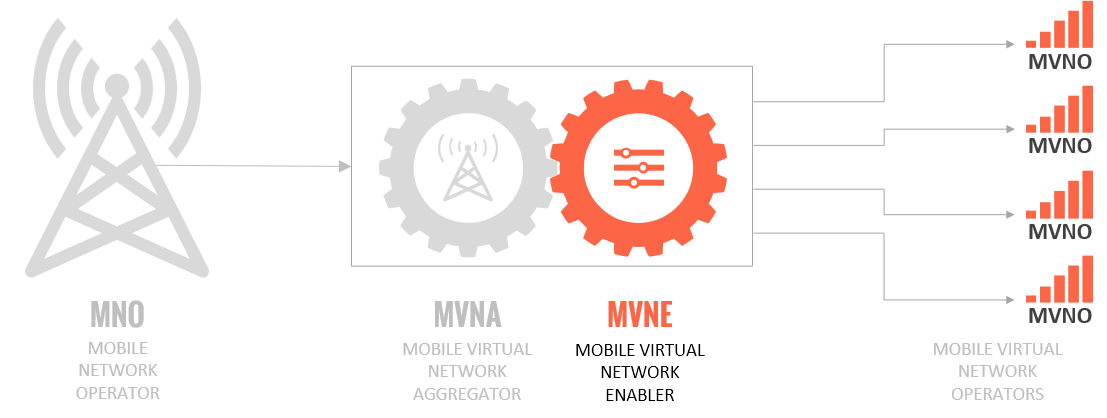
The MVNE’s operational model involves the installation and management of various Business Support Systems (BSS), Operations Support Systems (OSS), and core network elements. The architecture evolves with technological advancements, incorporating both legacy and 5G-specific components.
MVNE Components
- Intelligent Network (IN) / Service Control Point (SCP): These legacy components are used for call routing and advanced service logic, but their functionality is often superseded by or integrated into newer, more flexible 5G core elements.
- Signaling Transfer Point (STP) / Diameter Signaling Controller (DSC): These are essential for 2G/3G and 4G (LTE) signaling, respectively. In 5G, the Service-Based Architecture (SBA) largely replaces these with HTTP/2-based APIs for communication between network functions.
- Home Location Register (HLR) / Home Subscriber Server (HSS) / Unified Data Management (UDM): The HLR and HSS store subscriber data for 2G/3G and 4G networks. The Unified Data Management (UDM) is the 5G equivalent, which manages subscriber identifiers, authenticates users, and stores subscription data. The UDM works with the Authentication Server Function (AUSF) for secure authentication.
- Session Border Controller (SBC): This manages voice traffic and security at the network edge, particularly for VoIP (Voice over IP) and VoLTE (Voice over LTE) calls. It remains a key component for managing SIP (Session Initiation Protocol) signaling.
- Short Message Service Center (SMSC) / Short Message Service Gateway (SMS-G): These components handle the storage and forwarding of SMS messages, which are still a fundamental service.
- Interactive Voice Response (IVR) / Voicemail System (VMS): These are critical for managing voice-based services, such as automated menus and voicemail, and remain relevant in a 5G environment.
- Business Support Systems / Operational Support Systems (BSS/OSS): This is the overarching IT layer that handles business and operational processes. BSS includes customer relationship management (CRM), billing, and service management. OSS handles network inventory, fault management, and service provisioning. For 5G, these systems are enhanced to manage a wider range of services, including network slicing.
- Online Charging System (OCS) / Charging Function (CHF): The OCS provides real-time charging and billing for services like data usage. In the 5G core, the Charging Function (CHF) is the dedicated network function responsible for this, enabling flexible charging models based on services, time, and other parameters.
- Gateway GPRS Support Node (GGSN) / Packet Data Network Gateway (P-GW) / User Plane Function (UPF): The GGSN (2G/3G) and P-GW (4G) are gateways that connect the mobile network to the internet. The User Plane Function (UPF) is the 5G equivalent. It is a key element of the 5G core, responsible for the data plane, packet routing, and handling of user traffic. The UPF’s separation from the control plane allows for more flexible and distributed deployments.
- Unstructured Supplementary Services Data Gateway (USSDGW): This gateway handles USSD-based services, often used for simple menu-driven interactions like checking a balance or topping up a prepaid account.
In addition to the components above, a 5G-enabled MVNE stack will include several critical network functions that form the 5G Core (5GC). These are defined by a Service-Based Architecture (SBA).
- Access and Mobility Management Function (AMF): The AMF is the “brain” of the 5G control plane. It manages subscriber connections, handles mobility between different radio access technologies (e.g., 4G and 5G), and manages authentication and authorization. It is the first point of contact for a user equipment (UE) device.
- Session Management Function (SMF): The SMF manages user sessions and the establishment of PDU (Protocol Data Unit) sessions, which are the 5G equivalent of data connections. It assigns IP addresses and manages the routing of user traffic through the UPF.
- Network Slice Selection Function (NSSF): A key feature of 5G is network slicing, which allows operators to create dedicated virtual networks tailored for specific services (e.g., a slice for IoT devices or one for mission-critical applications). The NSSF helps a device select the appropriate network slice based on its subscription and the service it needs to access.
- Network Repository Function (NRF): The NRF acts as a central registry for all 5G network functions. It allows different functions to discover and communicate with each other, which is essential for the SBA.
- Policy Control Function (PCF): The PCF is responsible for policy control, defining rules for how network resources are used. It dictates things like Quality of Service (QoS) and roaming policies.
Host Network Components
The HNO, which provides the underlying mobile network infrastructure, is responsible for the core elements that the MVNO use to deliver services to its customers. The HNO’s responsibilities now extend to the 5G Core Network (5GC).
- Radio Access Network (RAN) / gNodeB: The HNO is always responsible for the RAN, which includes the cell towers, antennas, and all the equipment that connects user devices to the rest of the network. The 5G version of a base station is called a gNodeB.
- Packet Core / 5G Core (5GC) Functions: In a 5G environment, the HNO would provide the key 5G core network functions. This includes the User Plane Function (UPF), Session Management Function (SMF), Access and Mobility Management Function (AMF), Authentication Server Function (AUSF), and Unified Data Management (UDM). These new functions replace or work alongside the legacy 4G components like the MME, SGW, PGW, and PCRF.
- Voice Core (IMS): The HNO provides the voice core, which includes elements like the Media Gateway Controller Function (MGCF) and IMS-based Session Border Controller (IMS-SBC). These components are essential for enabling VoLTE and VoNR (Voice over New Radio) services. The legacy MSC and VLR for 2G/3G calls are still often part of the HNO’s infrastructure.
- Signaling and Routing: The HNO is responsible for the overall signaling and routing of traffic on its network. This includes the Diameter Routing Agent (DRA) for 4G and the Service-Based Architecture (SBA) for 5G, which is managed by the Network Repository Function (NRF).
- Database Management: The HNO manages key databases for the network, such as the Home Subscriber Server (HSS) for 4G and the Equipment Identity Register (EIR) to identify stolen or blacklisted devices. The Unified Data Management (UDM) for 5G handles subscriber data management.
- Connectivity: The HNO provides the essential connectivity to the outside world, including a robust connection to the Internet (ISP) and the management of Domain Name System (DNS) servers. They also manage the allocation of Public IPs and Network Address Translation (NAT) to ensure devices can connect to the internet.
MVNE Case Stories
Case 1: E-Plus Germany
Although the number of subscribers in the German market grew 11% between 2002-2005, the share for E-Plus grew just 4% in the same period, and the company’s EBITDA margin declined from 32% to 24%.
E-Plus recognized the potential of MVNOs and launched its MVNE and wholesale campaign in 2005.
The results was striking. E-Plus’s subscriber base grew by 18% between 2005 – 2008, and its EBITDA margin grew from 24% to 39%.
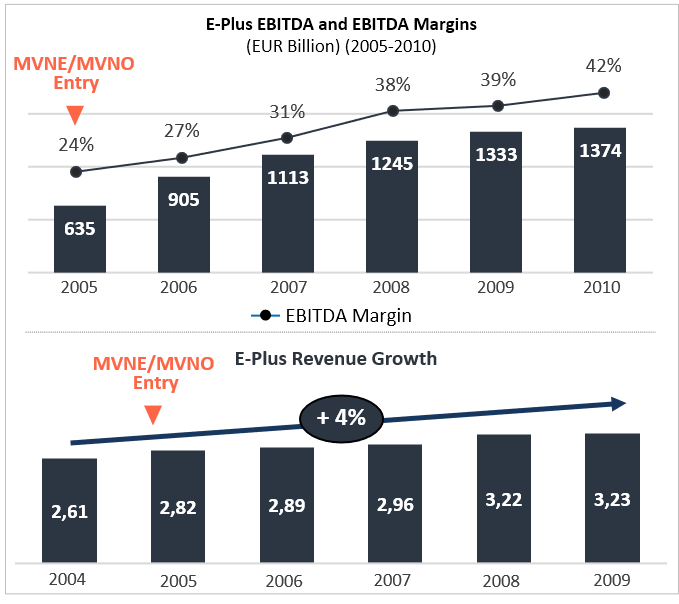
By 2009, E-Plus had launched 34 MVNOs through its MVNE and wholesale setup and increased its overall revenues to reach an EBITDA margin of 42% in 2010.
In 2014 Telefonica acquired E-plus for USD 9.7 billion to create the largest telecom services in Germany with almost 47 million customer.
Case 2: Tele2 Russia’s “MVNO Factory”
In May 2017, the Russian telecom operator Tele2 launched its “MVNO factory” strategy.
The strategy enabled Tele2 to host a range of MVNOs in various niches, and by mid-2017, it had six MVNOs operating, and contracts with eight more.
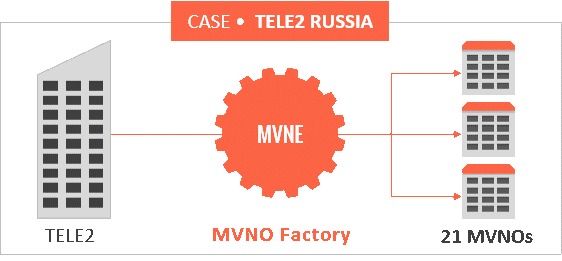
In 2018, MVNO subscribers in Russia grew to 3.2M with Tele2´s MVNOs accounting for 1.75M of those.
At the end of 2019, Tele2 had 21 MVNOs on its “MVNO factory”, serving 3.75M subscribers out of 10M total MVNO subscribers in the market – increasing Tele2’s revenue from the “MVNO factory” 133% year on year. Tele2’s goal is to occupy 10-12% of the market by 2023.
End of year 2020, the MVNO factory had 4.8M subscribers – with a revenue increase of 55% YoY.
Case 3: Internet Initiative Japan (IIJ)
Internet Initiative Japan (IIJ), runs a MVNE on the telecom operator NTT- catering to MVNOs, Internet of Things (IoT) and M2M providers.
From 1Q 2017 to 3Q 2017, the MVNO subscribers going through IIJ´s MVNE was 744,000 providing IIJ with a service revenue of USD 70 million.
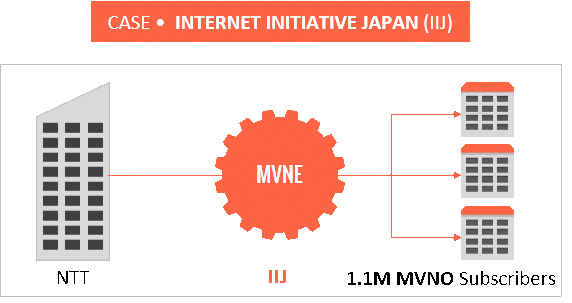
In the period 1Q 2018 – 3Q 2018, the number of subscribers grew by 254,560 to 998,892 total providing IIJ with a service revenue of USD 96.3 million up 37.8% YoY.
In 1Q 2Q19 the subscribers grew by 105,000 to reach a total of 1 million providing IIJ with a revenue of USD 115.1 million up 16.7% YoY.
FY2020, subscriptions through the MVNOs on IIJ’s MVNE platform was 1.1 million with a service revenue of USD 153 million.
Case 4: MVNA/MVNE Surf Telecom Brazil
In September 2015, the NRA, (Anatel) granted the company EUTV S.A, MVNO authorization. EUTV used its ”Surf Telecom” brand and the network of TIM Celular SA (TIM) to provide services as a MVNA/MVNE.
As of February 2021, Brazil had a total of 82 licensed MVNOs with 36 of them enabled by Surf Telecom.
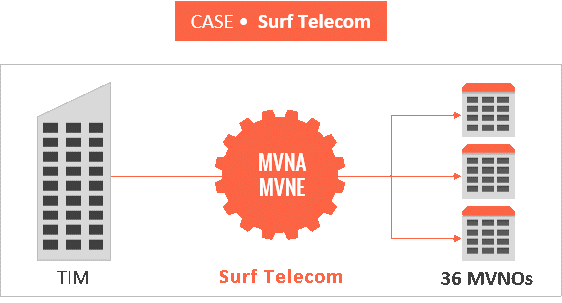
Among the MVNOs enabled by Surf Telecom are the Brazilian Post Office and several football teams.
As of Q1 2025, Surf Telecom and its MVNO partners had a total of 937,190 subscribers.
Strategies For a Strong Partnership Between MVNOs and MVNEs
- Establish Clear Communication and Transparency:
- Foster open and transparent communication channels between the MVNO and MVNE teams. This will ensure regular exchange of information, address concerns promptly, and build trust.
- Establish clear expectations and objectives for the partnership, outlining roles, responsibilities, and performance metrics. This will prevent misunderstandings and ensure alignment.
- Maintain regular meetings and communication channels at various levels within both organizations. This will facilitate collaboration, problem-solving, and ongoing relationship management.
- Align on Strategic Goals and Market Opportunities:
- Develop a shared vision and strategic plan that aligns the MVNO’s and MVNE’s goals for the partnership. This should consider target markets, customer segments, and product offerings.
- Collaborate on market analysis and customer insights to identify potential growth opportunities, untapped segments, and emerging trends. This will allow the partnership to jointly address these opportunities.
- Ensure Effective Service Level Agreements (SLAs):
- Establish comprehensive SLAs that clearly define the responsibilities of both parties. This includes network performance metrics, QoS guarantees, and response times for technical issues.
- Regularly review and update SLAs to reflect changes in business requirements, market conditions, and technological advancements. This will ensure the SLAs remain relevant and effective.
- Implement robust monitoring and reporting mechanisms to track SLA performance, identify potential issues, and measure the effectiveness of the partnership. This will provide data-driven insights to improve performance.
- Foster Collaborative Problem-Solving and Dispute Resolution:
- Establish clear protocols for handling disputes and resolving issues that may arise during the partnership. This will ensure a structured approach to conflict resolution.
- Encourage open communication and a willingness to compromise to find mutually beneficial solutions to challenges. This will foster a collaborative problem-solving environment.
- Consider involving external mediators or arbitration if necessary to reach an agreement and maintain the integrity of the partnership. This will ensure a neutral and impartial approach to dispute resolution.
- Promote Continuous Learning and Knowledge Sharing:
- Encourage regular knowledge sharing and collaboration between the MVNO’s and MVNE’s technical teams. This will help both parties stay up-to-date with technological advancements and industry best practices.
- Facilitate joint training and development programs to enhance employee skills, expertise, and understanding of the partnership’s objectives. This will ensure both teams are well-equipped to support the partnership.
- Promote a culture of open innovation and experimentation, allowing both parties to learn from each other’s experiences and successes. This will foster a dynamic and innovative partnership.
- Regularly Evaluate and Adapt the Partnership:
- Conduct periodic reviews of the partnership’s performance, assessing progress against agreed-upon goals, customer satisfaction metrics, and financial objectives. This will identify areas for improvement.
- Identify areas for improvement, potential synergies, and opportunities to expand the scope of the partnership. This will ensure the partnership remains relevant and effective.
- Adapt the partnership strategy based on market trends, technological advancements, and changing customer needs. This will ensure the partnership remains competitive and aligned with the evolving market landscape.
See more on our: 10 Key factors for MVNO success explained
MVNEs: Bridging the Gap Between MNOs and MVNOs
In summary, MVNEs are critical facilitators in the mobile telecommunications industry, empowering MVNOs to launch and grow by overcoming significant barriers to entry, while simultaneously enabling MNOs to expand market reach and revenue with reduced operational burden and risk. Their role is evolving with the adoption of 5G technologies, incorporating new architectural components to support advanced services and network capabilities.
MVNE - Frequently Asked Questions
A Mobile Virtual Network Enabler (MVNE) is an intermediary entity that provides infrastructure and services to both mobile network operators (MNOs) and Mobile Virtual Network Operators (MVNOs).
Essentially, MVNEs create a platform with technical solutions and business infrastructure services that facilitate the launch and operation of MVNOs, allowing them to offer services on an MNO’s network. Unlike MVNOs, MVNEs do not provide public telecom services directly to end-users and therefore are generally not subject to telecom regulation or licensing requirements.
An MVNE significantly differs from MVNOs and Mobile Virtual Network Aggregators (MVNAs) because it does not provide public telecommunication services or have direct contact with end-users.
Consequently, MVNEs are typically not subject to the telecom regulations or licensing requirements that often apply to MVNOs and MVNAs in many markets.
While rare exceptions exist where a national regulatory authority might include MVNEs under a licensing scheme, this is generally seen as an anomaly or a misunderstanding of the MVNE’s role. If an MVNE were to start providing services to end-users, it would then be subject to regulation as an MVNO.
Prospective MVNOs often encounter significant barriers to entry due to a lack of relevant experience in the wireless service delivery chain.
These challenges include high initial investment for IT infrastructure, a lack of specialized telecom knowledge and expertise, difficulty achieving economies of scale, limited understanding of the MNO/MVNO ecosystem’s technological and architectural aspects, and the overall operational complexity of running a telecom business (e.g., billing, customer service, SIM management).
MVNEs mitigate these issues by providing ready-made infrastructure, expert guidance, and a comprehensive platform, allowing MVNOs to focus on customer acquisition and service differentiation.
MVNEs provide substantial benefits to both MVNOs and MNOs. For MVNOs, MVNEs act as a partner, drastically reducing initial capital and operational expenditure (Capex and Opex), offering faster return on investment, and eliminating many integration issues.
They provide access to create and manage service plans, offer expert guidance, achieve economies of scale for lower rates/greater margins, and allow MVNOs to concentrate on customer acquisition by outsourcing operational complexities.
For MNOs, MVNEs save on infrastructure and subscriber acquisition costs, reduce the administrative workload associated with launching and operating individual MVNOs, and enable them to gain network market share and revenue with minimal risk.
MVNEs also help MNOs achieve better utilization of their network capacity and address specific/niche market segments through a diverse portfolio of MVNO clients.
An MVNE provides a comprehensive suite of technical solutions and business infrastructure services. This often includes Business and Operations Support Systems (BSS/OSS) for customer management, billing, and network operations. Key core network elements provided or managed by an MVNE can span across different mobile generations.
For instance, legacy components like Intelligent Network (IN)/Service Control Point (SCP), Signaling Transfer Point (STP), Home Location Register (HLR), and Short Message Service Center (SMSC), are often part of the MVNE stack.
For 4G and 5G, MVNEs integrate elements like:
- Home Subscriber Server (HSS)/Unified Data Management (UDM),
- Session Border Controller (SBC),
- Online Charging System (OCS)/Charging Function (CHF),
- Packet Data Network Gateway (P-GW)/User Plane Function (UPF),
and for 5G, new functions like:
- Access and Mobility Management Function (AMF),
- Session Management Function (SMF),
- Network Slice Selection Function (NSSF),
- Network Repository Function (NRF),
- Policy Control Function (PCF).
The MVNE provides the platform, technical solutions, and business infrastructure services to enable MVNOs. This includes BSS/OSS, core network elements (which can be hosted by the MVNE or provided through the HNO), and managed services.
The Host Network Operator (HNO), on the other hand, is responsible for providing the underlying physical mobile network infrastructure. This always includes the Radio Access Network (RAN), which consists of cell towers and antennas (gNodeB in 5G).
In a 5G environment, the HNO also provides key 5G core network functions such as:
- User Plane Function (UPF),
- Session Management Function (SMF),
- Access and Mobility Management Function (AMF),
- Authentication Server Function (AUSF),
- Unified Data Management (UDM).
Additionally, the HNO manages the Voice Core (IMS), overall signaling and routing (including Diameter Routing Agent for 4G and SBA for 5G), database management (HSS, EIR, UDM), and essential connectivity to the internet.
Business Support Systems (BSS) and Operations Support Systems (OSS) form the overarching IT layer that handles the business and operational processes of a mobile network.
For an MVNE, these systems are critical for supporting MVNOs.
BSS encompasses functionalities related to customer interactions and revenue management, such as Customer Relationship Management (CRM), billing, charging (e.g., Online Charging System/Charging Function), and service management. OSS, conversely, focuses on managing the network infrastructure and services.
This includes network inventory management, fault management, performance monitoring, and service provisioning. In a 5G context, these systems are enhanced to handle a wider range of services, including advanced features like network slicing.
There is no specific “MVNE license” required because an MVNE does not provide public telecommunication services directly to end-users.
Their role is upstream, providing infrastructure and services to other entities (MVNOs and MNOs) rather than interacting with the final consumers of telecommunication services.
As they do not offer services that are subject to public telecom regulation, they are exempt from the licensing schemes that apply to MVNOs and MVNAs. Any instance of a regulatory authority imposing an MVNE license is typically considered an anomaly or a confusion with other MVNx models.
Additional MVNE Information
Check out our podcast: “Enabling MVNO Success: A Guide to MVNE” – on Spotify or SoundCloud
See Also:
- Introduction to MVNA, MVNE, MVNO
- MVNA MVNE MVNO Explained
- MVNO Strategy: Market Differentiation and Segmentation
- MVNO Objectives: Generate telecoms revenues or cross-sell core business
- MNO & MVNO Partnerships: From Old Fears to New Revenue
- MVNO Business Models
- MVNO Types & Operational Models
- Reseller MVNO (Branded Reseller)
- Service Provider MVNO (Thin MVNO)
- Enhanced Service Provider MVNO (Medium MVNO)
- Full MVNO
- Mobile Virtual Network Aggregator (MVNA)