Mobile Virtual Network Aggregator (MVNA): A Comprehensive Guide
This is custom heading element

Aggregate, comes from the Latin verb, “aggregāre”, which means, to add to – or collect into a mass or whole. An MVNA aggregates, a mass amount of data (Voice, SMS, Data) from mobile operators, and resell it to MVNOs.
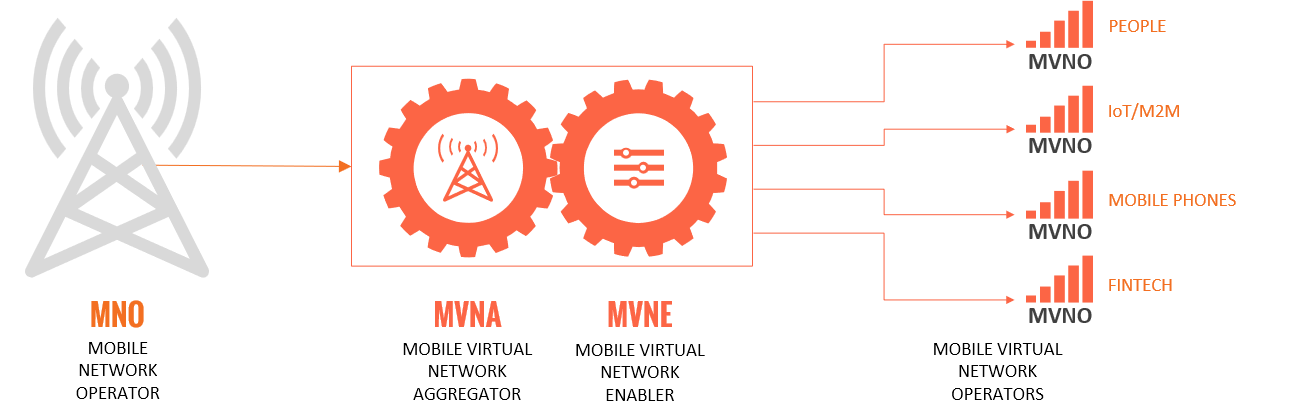
The MVNA is an entity, which purchases mobile airtime in bulk from a mobile network partner (mobile network operator), and then wholesales this airtime and service to multiple MVNOs, who each in turn sells the mobile service to end-users. The MVNA acts as a middle-man between the mobile operator (MNO) and the MVNOs.
MVNA Definition and Core Function
A Mobile Virtual Network Aggregator (MVNA) is a Business-to-Business (B2B) entity that acts as a crucial intermediary in the mobile telecommunications ecosystem. Its core function is to:
- Aggregate mobile airtime in bulk from Mobile Network Operators (MNOs). The term “aggregate” comes from the Latin verb “aggregāre,” meaning “to add to – or collect into a mass or whole.”
- Wholesale this airtime and its own services to multiple Mobile Virtual Network Operators (MVNOs).
- MVNAs do not serve end-users directly. The MVNA acts as a middle-man between the mobile operator (MNO) and the MVNOs and does not serve end-users.
MVNA Benefits for the MVNO Ecosystem
The introduction of MVNAs has significantly streamlined and optimized the MVNO ecosystem, creating a win-win-win situation for both the MVNO, MVNA and MNO.
MVNAs play a pivotal role in fostering a dynamic and efficient MVNO ecosystem by providing critical aggregation, strategic support, and economies of scale, while also necessitating clear regulatory distinctions from MVNOs to ensure fair competition and market stability.
Benefits for Mobile Virtual Network Operators (MVNO)
- Economies of Scale and Favorable Pricing: Individually, “An MVNO by itself, lacks economy of scale in order to negotiate favorable pricing terms for airtime with the mobile network operators. MVNAs overcome this by consolidating the purchasing power of multiple MVNOs, enabling them to secure bulk deals, at discounted rates, passing these savings on to their MVNO clients. This creates economies of scale benefits, similar to any other, manufacture-wholesale-retail ecosystem.
- Reduced Risk of MNO Competition: MVNAs offer an additional layer of security for MVNOs. By sharing business models and KPIs with the MVNA instead of directly with the MNO, MVNOs can mitigate the risk of their innovative services and promotions being copied and launched prematurely by the MNO.
- Strategic Guidance and Support: Many aspiring MVNOs lack the necessary telecom industry expertise. The MVNA serves as a vital important partner role, guiding MVNOs’ marketing, user acquisition and channel development strategies. They provide support in areas such as marketing strategy development, customer acquisition campaigns, and channel partner selection.
- Tailored Offers: MVNAs can provide tailored offers that suit the needs and individual business models of each MVNO.
Benefits for Mobile Network Operators (MNO)
- Efficient Bulk Sales: MNOs can sell large discounted airtime bulk to the MVNA, without the normal associated costs of selling to different MVNOs. This simplifies the MNOs wholesale operations.
- Increased Market Reach: By partnering with an MVNA, MNOs can indirectly reach a broader range of niche markets and customer segments through multiple MVNOs without the direct overhead.
Essential Capabilities and Roles of an MVNA
To be successful, an MVNA requires a diverse set of skills and capabilities:
- Deep Industry Knowledge: MVNAs must have a solid understanding of the mobile industry, including network technologies, pricing strategies, and customer behavior. This is crucial for analyzing MVNO business models, validating subscriber and traffic forecasts, and maintaining strong relationships with both MNOs and MVNOs.
- Customization and Innovation: MVNAs will have to harness the skills necessary to conceive and build customized offers for multiple MVNOs. They need to be able to transform the vision of each MVNO partner into marketable, functional offers, featuring an attractive set of mobile products and services.
- Negotiation Skills: The MVNA must obtain flexible and competitive wholesale network agreements with the mobile network operators.
- Operational Expertise: MVNAs are involved in a wide array of operational aspects, including:
- Identify the niche and value proposition,
- Customer Segmentation and needs,
- Product Portfolio,
- Tariffs, Bundles, Voucher, Fraud,
- Advertising and Promotions,
- Subscriber Analysis,
- New Product and Application Specification,
- Legal compliance,
- Infrastructure Investment (or Partnership): An MVNA may deploy certain elements, which allows it to execute functions for billing, monitoring and reporting, management of numbering resources, business intelligence. and other services. Alternatively, it can invest in these resources directly – or via a partnership with a Mobile Virtual Network Enabler (MVNE),
- Definition of sales & payment channels,
- SIM Cards,
- Channel, and Distribution Management.
- Business Intelligence Reporting,
- Bundle and promotion offer development,
- Customer acquisitions & retention campaigns,
- Improvement of operational processes,
- ARPU, Churn management,
- Best time to market (launch services),
- Flexible and enhanced life cycle configuration,
- eSIM Adaptation: As eSIM spreads, there will be a growing demand for MVNA-type players who can negotiate agreements between different operators that provide automatic remote service when users cross borders.
MVNA Licensing and Regulatory Distinction
The critical distinction between MVNA and MVNO licenses:
- Conflict of Interest and Operational Issues: Historically, some markets allowed MVNOs to also act as MVNAs. However, this creates a range of issues. A key concern is the strong conflict of interest when an MVNO acts as an MVNA, as it will have access to the data of its MVNO clients, and may prioritize its own end-user business over the needs of its MVNO clients.
- Consumer Protection vs. B2B Focus: MVNOs deliver its services to end-users and is therefore also bound by consumer focused laws and protections, requiring customer support. In contrast, an MVNA does need to do so as in does not have end-users.
- Business Continuity: Concerns arise about what happens if the MVNO that is also acting as a MVNA by providing service to other MVNOs – goes out of business? Who will take over the operation to maintain connection for the other MVNOs?
- Separate Licensing Recommended: Due to these issues, regulatory authorities, such as the National Broadcasting and Telecommunications Commission (NBTC) in Thailand, realized the issues mentioned above and have since separated MVNO and MVNA licenses into distinct categories. This approach allows for tailored application processes, specific licensing requirements, and differentiated regulatory treatment for each business model.
MVNA - Frequently Asked Questions
MVNAs offer several key advantages to MVNOs. Primarily, they provide MVNOs with economies of scale.
Individual MVNOs often lack the purchasing power to negotiate favorable wholesale rates directly with MNOs. By aggregating the demand of multiple MVNOs, an MVNA can secure highly discounted bulk rates from MNOs, passing these savings on to its MVNO clients.
This model mirrors traditional manufacturing, wholesale, and retail structures.
Additionally, MVNAs offer a layer of security; MVNOs can share their business models and Key Performance Indicators (KPIs) with the MVNA rather than directly with the MNO, reducing the risk of the MNO copying and prematurely launching similar services or promotions.
MVNAs provide significant benefits to MNOs by streamlining their wholesale operations. MNOs can sell large volumes of discounted airtime and data to a single MVNA, eliminating the complex and costly process of negotiating with and managing numerous individual MVNOs.
This allows MNOs to efficiently monetize their excess network capacity without incurring the overhead associated with serving a multitude of smaller clients, ultimately making the airtime distribution process more efficient.
To be successful, an MVNA must possess a diverse set of skills and capabilities. This includes deep industry knowledge, strong analytical skills, and prior MVNO experience.
They need to be adept at transforming the unique visions and business models of their MVNO partners into marketable and functional mobile offers, encompassing product portfolios, tariffs, bundles, and marketing strategies.
Furthermore, MVNAs must be capable of understanding, supporting, and even constructively questioning MVNOs’ business models, subscriber, and traffic forecasts. They also need to maintain robust ongoing relationships with both MNOs and MVNOs, requiring flexibility, agility, and a shared vision to ensure both parties achieve their goals.
MVNAs play a vital strategic partner role in guiding MVNOs’ marketing, user acquisition, and channel development strategies.
Many potential MVNO candidates may not have the necessary telecommunications expertise to effectively apply existing marketing or distribution knowledge to the telecom sector.
The MVNA fills this gap by assisting with crucial aspects like identifying niche markets and value propositions, customer segmentation, product portfolio development, advertising and promotions, subscriber analysis, and defining sales and payment channels. They also help with legal compliance, SIM card management, and distribution.
The increasing adoption of eSIM technology is expected to significantly amplify the demand for MVNA-type players.
As users frequently cross borders, there will be a growing need for MVNAs to negotiate complex agreements between different mobile operators. This will enable seamless, automatic remote service provisioning for subscribers, ensuring uninterrupted connectivity and a consistent user experience regardless of their geographical location.
The distinction between an MVNA and an MVNO license is crucial due to their differing roles and responsibilities.
An MVNO delivers services directly to end-users and is therefore subject to consumer protection laws, requiring extensive customer support.
In contrast, an MVNA is a B2B entity that does not serve end-users and thus doesn’t require the same consumer-focused infrastructure.
Allowing an MVNO to also act as an MVNA creates conflicts of interest, as the MVNO would have access to its competitors’ (other MVNOs’) data and might prioritize its own end-user business.
Furthermore, if an MVNO acting as an MVNA fails, it poses a risk to the continuity of service for its client MVNOs.
Regulatory authorities, such as the NBTC in Thailand, have recognized these issues and have moved to separate MVNO and MVNA licenses with distinct application processes, terms, and conditions, ensuring a more stable and fair ecosystem.
While an MVNA primarily aggregates services from MNOs, it can choose to invest in and deploy certain elements of its own infrastructure to optimize operations and cater to the specific needs of its MVNO clients.
These elements might include systems for billing, monitoring, reporting, managing numbering resources, and business intelligence.
Alternatively, an MVNA can partner with a Mobile Virtual Network Enabler (MVNE) to acquire these essential services. This flexibility allows MVNAs to tailor their operational model to best suit their business strategy and the diverse requirements of the MVNOs they serve.
Additional Information
Check out our podcast: A Guide to Mobile Virtual Network Aggregators (MVNA)” – on Spotify or SoundCloud
See Also:
- Introduction to MVNA, MVNE, MVNO
- MVNA MVNE MVNO Explained
- MVNO Strategy: Market Differentiation and Segmentation
- MVNO Objectives: Generate telecoms revenues or cross-sell core business
- MNO & MVNO Partnerships: From Old Fears to New Revenue
- MVNO Business Models
- MVNO Types & Operational Models
- Reseller MVNO (Branded Reseller)
- Service Provider MVNO (Thin MVNO)
- Enhanced Service Provider MVNO (Medium MVNO)
- Full MVNO
- Mobile Virtual Network Enabler (MVNE)