NBTC’s “Blue Flag” Telecom Plan: A Red Flag for Fair Competition
This is custom heading element
NBTC Blue flag package is a Red Flag for MVNO and market competition.
The recent idea by Thailand’s National Broadcasting and Telecommunications Commission (NBTC) to push for a so-called “Blue Flag Packages” priced no more than 240 baht/month raises a Red flag.
While seemingly consumer-friendly, the “order” raises significant concerns about the regulator’s commitment to genuine competition and its oversight of the telecom market, particularly in the wake of the TRUE/DTAC merger.
Instead of fostering a truly competitive environment, this directive will solidify the duopoly and their inflated prices in the market, as well as absolving the NBTC from its critical duties.
Legitimizing Inflated Prices and Solidifying Duopoly
The NBTC’s decision to cap a “basic” package at 240 baht per month, while presented as a win for consumers, de facto acknowledges and legitimizes the current elevated pricing structure that has emerged following the TRUE/DTAC consolidation.
It inadvertently provides AIS and the merged TRUE/DTAC entity with a convenient “blanket” to maintain their artificially inflated pricing across the board. It allows them to keep the previously affordable entry-level packages removed, knowing that the NBTC has set a new, higher baseline for what it considers “affordable.”
A Convenient "Blanket" Undermining Genuine Market Competition
This action primarily serves the interests of the dominant operators by validating their current pricing strategies. It allows them to avoid the pressure of truly competitive market forces that would naturally drive down prices across all services.
Rather than creating a vibrant and competitive market, this directive entrenches the existing duopoly. It sends a signal that the NBTC is content with a market where two major players dictate terms, rather than fostering an environment where multiple providers compete vigorously for consumers.
Sidestepping Crucial Merger Stipulations
More alarmingly, this action sidesteps the NBTC’s own merger conditions imposed on TRUE. Among these conditions were crucial stipulations for MVNO (Mobile Virtual Network Operator) access and a 12% pricing reduction across TRUE’s services.
The NBTC’s struggle to enforce these conditions, is perplexing given its role as the industry regulator and its own collection of comprehensive pricing data.
The Sustainable Solution: Empowering MVNOs
Consider the analogy: Instead of giving the man a fish and feeding him for a day, the NBTC should be teaching the man how to fish so he can survive. The “Blue Flag Package” is a temporary handout. The sustainable solution, the “fishing lesson,” lies in the vigorous enforcement and promotion of regulations on MVNOs and wholesale access.
By truly opening up the market to real competition, the NBTC could allow market forces to naturally drive down prices to a genuinely fair and competitive level, not just for one specific package, but for all mobile services.
Discrepancy with Existing Lower-Priced Offerings
The absurdity of the 240 baht price point becomes even clearer when examining the market.
AIS’s and Singtel’s sub-brand (GOMO) already offer packages at lower prices.
By way of example the “Gomo-Fun” yearly package for 2,799,- (THB 234,- per month) which comes with:
- 100GB data per month.
- 60 minutes voice calls
Definitively proving that it is not only possible but commercially viable to provide mobile services below the NBTC’s new “cap.”
This stark contrast highlights the artificially inflated nature of the other packages and the current market’s lack of genuine competition.

Questions of Transparency and Pre-Announcement Availability
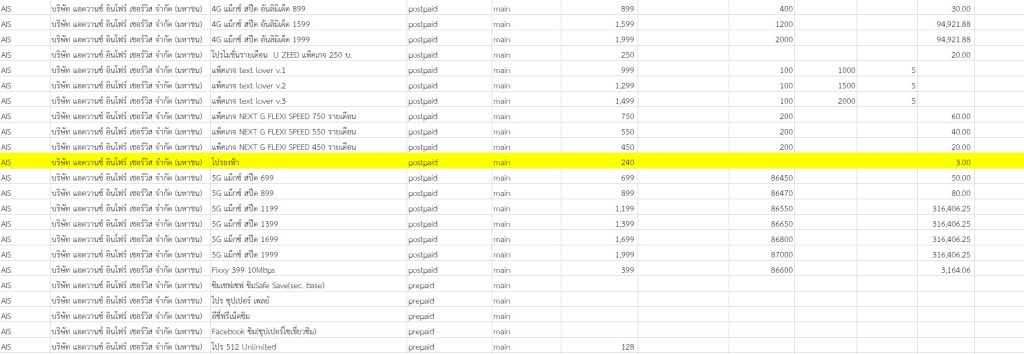
More perplexing still, how is it that the “Blue Flag Packages 240 baht,” ostensibly designed as a new consumer offering, were seemingly available through AIS before the NBTC’s official announcement?
In addition it was also available in NBTC’s own Mobile Phone Service Promotion Data Set
This raises serious questions about the transparency of the process and whether the regulator is truly setting a new standard, or merely legitimizing existing, more affordable offerings under a new name, thereby excusing the higher prices of the main brands.
Images: From AIS website and NBTC’s Data set where the Blue Flag 240 baht package was already available


Perplexing Claims on Data Acquisition
The NBTC’s continued claims of difficulty in obtaining data for the mandated 12% pricing reduction on TRUE are, frankly, “interesting.” The NBTC, as the primary regulator, should inherently possess the necessary data to monitor and enforce such conditions.
In fact, data sets from the NBTC itself provides clear insights into the pricing of various services, including SMS, voice calls, MMS, and data, from each operator.
These figures, which do not even include the potentially lower prices from sub-brands like AIS’s “GOMO” or TRUE’s “Finnmobile” (which should be factored in to truly reflect the market), demonstrate that the NBTC holds the keys to understanding and assessing pricing structures but someone is holding the door.
Image: NBTC’s Data set of average service rates for domestic mobile phone services

Moving Beyond Superficial Interventions
The NBTC needs to stop these superficial interventions, such as the “Thailand Independent Market Operator (TIMO)” and the “Blue Flag Package.” These are essentially a “reset button,” talking about unproven or impractical concepts that distract from the NBTC’s failure to enforce its own regulations. Such new ideas only serve to remove focus on NBTC’s neglect of duty on enforcing its existing policies and introduce new ones that can be delayed.
Prioritizing and Enforcing Existing Policies
Instead, the NBTC must enforce and demonstrate their fundamental commitment to its existing polices on genuine competition.
This means:
- Aggressively enforcing the TRUE/DTAC merger conditions, particularly the 12% price reduction and robust MVNO access.
- Actively promoting and regulating wholesale access to the networks of dominant operators, enabling MVNOs to truly thrive and offer competitive alternatives.
- Utilizing its own extensive data to accurately assess market pricing and hold operators accountable for fair practices.
The Way to Fairer Prices and Consumer Welfare
The “Blue Flag Package” is nothing but a symbolic gesture, doing little to address the underlying issues of a concentrated market and inflated prices, leaving Thai consumers to bear the burden of a system that prioritizes the profits of few over the welfare of the many.
The time for genuine market reform, driven by strong regulatory oversight and a commitment to competition, is long overdue.