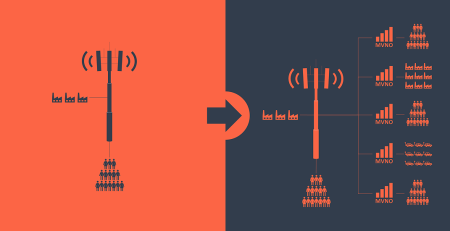
The History of MVNO
This is custom heading element
Although the first Mobile Virtual Network Operator (MVNO) in the world “Virgin Mobile UK”, was launched in the United Kingdom on November 1999, the history of MVNO dates back to the early 1990’s Europe, along with MVNO pioneers in the Nordic countries, especially Denmark and Norway.
Check out our podcast: “The History and Revolution of MVNO” – on Spotify or SoundCloud
For a visual deep-dive, watch our video on The Great Disruption: The History and Revolution of MVNO.
Hi, and welcome to Yozzo’s podcast dedicated to empowering mobile virtual network operators with the insights they need to succeed.
This is the place where we break down the complexities of the MVNO ecosystem. Let’s get started.
All right. Today we’re going to talk about a revolution. One that you’ve probably never even heard of, but it happened right in the palm of your hand and it completely flipped the entire mobile industry on its head.
It’s the story of how a few smart rule changes and some even smarter companies completely broke open a closed system and gave us all the choices and prices we expect today.
I mean, really think about it for a second. Why do you have so many choices for your phone plan? You can get one from your cable company, a big box store, or from dozens of online brands. It feels normal now, but it definitely wasn’t always this way.
The answer is tucked away in a concept that quietly rewired everything. And that answer is the MVNO. It stands for mobile virtual network operator.
So, what is it? Simply put, it’s a mobile company that doesn’t actually own any of the cell towers or physical network stuff. They’re basically renters. The big network owners are the landlords with a building. And the MVNOS’s just lease some space on their network and sell it directly to you, but with their own branding, plans, and prices.
A simple idea, right? But with absolutely massive consequences. To really get just how revolutionary this was, we’ve got to jump in a time machine.
We need to go back to a world where choice wasn’t really a thing. Before the late 90s, in most countries, you only had maybe two or three options for a mobile phone plan. And these were usually huge old school companies, often with ties to the government.
With no real competition, they had zero reason to lower prices or come up with cool new features. You wanted a mobile phone, you paid what they told you to pay. End of story. So, what broke the dam? How did we get from that locked down system to the wide open market we have now?
Well, the whole thing started with a single piece of legislation in Europe. This was the spark that lit the whole fuse. And this is it. It looks pretty boring, right? Directive 9562/ec.
But don’t let the name fool you. This document was basically a stick of dynamite tossed into the cozy world of the telecom monopolies. It laid down the law that would force them to open up their networks. And this directive was super specific.
It wasn’t a suggestion. It was a mandate called open network provision. It meant the big dominant network owners were now legally required to let other companies access their infrastructure and no funny business either.
The access had to be fair, transparent, and you couldn’t discriminate. With a hard deadline of January 1st, 1998, the clock was officially ticking. Now, a law is just words on paper until somebody actually decides to test it. and the first pioneers to step up and challenge the giants.
Well, they were in for one heck of a fight. Meet Sense Communications, a Norwegian company. They were the first ones to really try and use this new law, and it was a total roller coaster.
They’d win a legal battle, then get shut down by another regulator. The big networks fought them tooth and nail until Sense eventually went under 99. They did come back a year later, but man, that first battle was absolutely brutal.
The whole legal war came down to this kind of nerdy but totally critical distinction. Sense wanted what’s called interconnection, which would let them be a real independent competitor with their own SIM cards and everything. But the big guys argued, “No, no, all they’re doing is roaming, which would keep all the control and power in their hands.”
The regulators couldn’t agree, and that confusion is really what killed Sense’s first attempt. But while Sense was slugging it out in the legal trenches in Scandinavia, a totally different kind of company was about to blow the whole game wide open from a completely different direction.
And this was the moment. November 11th, 1999, Virgin Mobile launches in the UK. This is it. The birth of the world’s first truly successful MVNO.
They didn’t just try to get a foot in the door. They kicked it down and built a massive business in a huge market. You can hear their whole strategy right here in this quote from Richard Branson. Simplicity. No more confusing plans and hidden fees. Just one single simple tariff.
They knew their weapon wasn’t going to be technology. It was going to be their brand’s reputation for being fair and easy to understand. So what was their secret sauce? First, they took a famous, trusted brand from a totally different industry and dropped it into this stale telecom world.
Then they found a network partner who was willing to play ball. And they focused like a laser on simple, honest pricing. What Virgin really did was prove that you didn’t have to be a telecom insider to win in the mobile business. So Virgin proved it could be done. They cracked the door open.
But it was in Denmark where a couple of scrappy startups basically took that door off its hinges and perfected a new super efficient way of doing things.
And the results were, well, look at this. It was a market earthquake. By the end of 2003, the big old network owners in Denmark were actually losing customers. Meanwhile, the new virtual operators saw their customer base grow by a staggering 74%. That’s not just competition. That’s a hostile takeover of market growth.
So, how on earth did they do it? A company called Telmore basically wrote the playbook. They were a lean machine. Everything was online, so they didn’t need expensive retail stores. They started with just 20 people and they didn’t get into the messy business of subsidizing phones.
This meant their costs were tiny compared to the big guys and they passed all those savings right on to their customers. And did this model work? Oh yeah. In just 3 years, three, this tiny online startup, Telmore, managed to capture 9% of the entire Danish mobile market. They went from nothing to a major force almost overnight.
And here’s the best part of the story. The country’s biggest network, TDC, the very landlord that Telmore was renting from, was so blown away by their success that they just bought them for 400 million Danish Kroner. It was the ultimate, if you can’t beat them, buy a moment. And it completely proved that the MVNO model was here to stay.
So what began as a legal fight in Scandinavia and a cool marketing play in the UK, it didn’t stay there. It went global and it went global fast and I mean it exploded. By 2018 you had over 1,300 of these virtual operators in 80 different countries. This wasn’t some niche idea anymore. It had become a massive $84 billion global market and it all grew from that one European directive.
And you can see the impact everywhere. Just look at Denmark where the whole lean model was perfected. Virtual operators have over a third of the entire market. And it’s not just a small country thing. In huge economies like Germany and the UK, they’ve got massive chunks of the pie, too. Proving this model works anywhere.
So, let’s bring this all home. Why does any of this matter to you and the phone in your pocket? It’s simple. This whole revolution injected real fierce competition into the market that drove prices down by as much as 50% in those early Danish days.
It created the insane amount of choice you have today. And it forced everyone, big and small, to actually innovate to earn your business.
And that wraps up another episode of Yozzo’s podcast. If you want to dive deeper into today’s topic, you can find much more resources at yoozo.com. We’ll be back next time with more insights. Until then, keep innovating.
The Directive That Paved the Way for MVNOs
While there were earlier examples of companies reselling mobile services, particularly in the U.S. and Japan, it is important to understand that these were fundamentally different and were not MVNOs.
These were arrangements between two different types of telecom companies, such as a mobile network operator (MNO) and a long-distance or regional carrier. The story here concentrates on true Mobile Virtual Network Operators (MVNOs), which are defined as companies that are not active in the telecom sector and do not own any network infrastructure.
Up until the late 1980’s telecom markets and telecommunication infrastructure, was mostly dominated by government controlled monopolies.
Yet, the approach towards liberalization in telecommunication was broadened significantly in Europe in 1993, with the issuing of directives concerning liberalizations of voice telephony, and the interconnection of public and private networks.
The most important directive in that regard was: Directive 95/62/EC of the European Parliament, 13 December 1995 – The application of open network provision (ONP) to voice telephony.[1]

The directive was the beginning to the liberalization of telecommunication infrastructure and services in Europe, as it required EU member states to secure that any service provider, which obtains a dominant position in the market (Significant Market Power or SMP), had to grant access to their network on a transparent, fairly priced, and non-discriminatory basis.
By January 1st, 1998 – Any telecom operator had the right to interconnect with public networks at cost-related charges in Europe (EU).
The Nordic MVNO Pioneers
Although the full liberalization of most EU member states’ telecommunications markets occurred in 1998, the Nordic countries, and Denmark in particular – was among the early adopters. The Danish government established a political agreement on liberalization in 1995, resulting in the introduction of full competition in July 1996 ahead of the European Union deadline.[2]
Two years later, in 1998 – the Norwegian company Sense Communication (Net system International), was ready to challenge the duopoly of Telenor and Netcom in Norway,[3] and thus taking the first steps towards what we today know as Mobile Virtual Network Operator (MVNO).
Sense’s plan was to enter into interconnection agreements, with the mobile operators Sonofon in Denmark, Sonera in Finland, Telenor in Norway and Telia in Sweden.
However, Sense’s proposal included the use of its own Mobile Network Code (MNC) and Subscriber Identity Module (SIM) cards as part of the arrangement, which resulted in the mobile operators refusing to give Sense access to their networks, on the grounds that acceptance of another operator’s SIM card was considered roaming, and roaming was not interconnection.
As a consequence, of the rejection from the operators, Sense launched a dispute with the respective National Telecommunications Authorities (NRA).
In September 1998, the Norwegian NRA – Post- og teletilsynet (Nkom today) ruled in favor of Sense:
The mobile network operators in Norway appealed against the ruling, and the Ministry of Communications decided to examine the matter, resulting in a report on the fundamental questions raised by the MVNO concept, being presented to the Norwegian Parliament in Autumn 1998.
In February 1999, the Danish NRA decided that the mobile operator, Sonofon had an obligation to meet Sense’s requests.
However, it decided that Sonofon was not required to route calls received from mobile terminals with SIM cards containing Sense’s own MNC code, because it constitutes the same functionality as roaming between mobile networks.[4]
Just like the Danish NRA, the Swedish NRA decided that the network operator, Telia, was not required to accommodate Sense’s request for access, on the basis that the form of connection requested, was roaming and not interconnection.
The National Telecommunications Authorities was now aware of the concept of Mobile Virtual Network Operators, and believed it would be beneficial to the competitiveness of the mobile market and as a result, proposed amendments which would oblige networks to provide access to MVNOs.[5]
Although obtaining support from the National Telecommunications Authorities, it was too little – too late, and Sense succumbed due to the lack of agreements with the operators.[6]
Despite the obstacles, Sense managed to return[7] from bankruptcy, under a new form in April 1999, with another MVNO operational model, aligning themselves more with the mobile network operators – and in November 1999, Sense, now named Sense Communications, signed a service provider agreement with Telenor and Swedish Telia, for GSM network capacity access, allowing Sense to offer its services, to its own customers in Norway and Sweden.

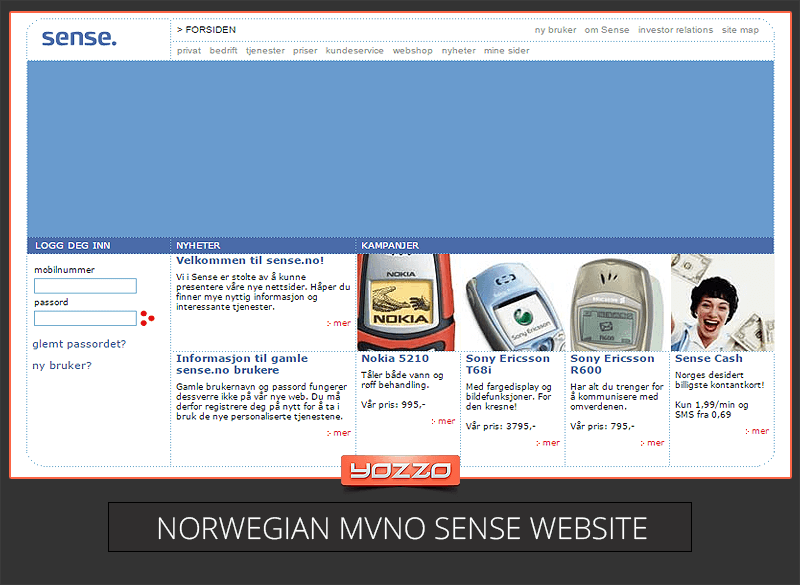
Sense launched its service in Norway on January 17, 2000 – two month after the launch of the first MVNO in the world (see below), with a yearly target of 70.000 subscribers and a promise to break up the mobile duoply in Norway.[8]
During the first 3 months of operation, Sense manage to add 35.000 subscribers, half of its yearly target, and 4 times as much as the second mobile operator in Norway, NetCom (8.671 new subscribers).
Sense’s host operator, Telenor managed to add 81.598 subscribers in the same period for a total of 2.060.157 subscribers.
World’s First MVNO Launched in the UK
Meanwhile in the United Kingdom, The Office of Telecommunications, Oftel (now: Ofcom) had become aware of what was now known as Mobile Virtual Network Operators (MVNOs).
Oftel’s review of the MVNO concept, had been to obtain an assessment of the state of policy development on this issue in other European countries, and had noticed the Sense’s negotiations in Scandinavia, demonstrated some regulatory issues, when commercial negotiations failed.
In June 1999, Oftel launched a consultation document to gain possible stakeholders views on the potential introduction of MVNOs into the UK market.
Five months later, on 11-11-1999, the world saw the launch of the first MVNO “Virgin Mobile UK”, a 50:50 private joint-venture company (Virgin Mobile Telecoms Ltd.) between Virgin Group, and Deutsche Telekom’s One2One.
While there were earlier examples of companies reselling mobile services, particularly in the U.S. and Japan, these were typically arrangements between two different types of telecom companies, such as a mobile network operator (MNO) and a long-distance or regional carrier. These were essentially inter-carrier partnerships, not a brand from a completely separate industry entering the space.
Virgin Mobile’s launch was a significant moment because it proved that a company with a strong consumer brand, but no existing telecom infrastructure, could successfully leverage a network operator’s services to create a new business. This model paved the way for the diverse MVNO market we see today, with companies ranging from supermarkets to media brands offering their own mobile services.
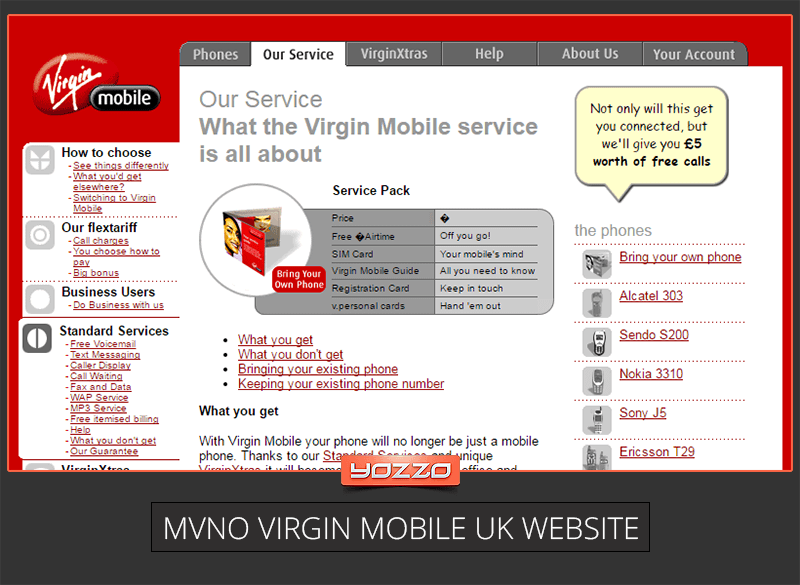
Virgin Mobile was targeting 1 million customers by March 2000, which would give it a 6% market share.
The launch was to be followed up with an advertising campaign of £20 million. Virgin expected to invest around £50 million before seeing a return in the company’s second year.
Richard Branson of Virgin Group told the Register[9], that Virgin Mobile would have one tariff. Calls would be priced per day. The first 10 minutes would cost 15 pence/min, the next 10 minutes would be ten pence/min, and the rest of the day is charged at five pence/min.
Virgin Mobile was using One2One as its host operator and Richard Branson said the company was “braver” than the other networks, and would let Virgin Mobile compete direct in the market.
Not one, not two - but three MVNOs
The Danish mobile network operator Sonofon, who initially refused access to Sense Communications back in 1998, entered into two MVNO agreements on August 2000, with the MVNO’s Club Blah Blah and Tele2 A/S.
Club Blah Blah (CBB Mobil), became Denmark’s first MVNO, when it launched on 1. October 2000.
Tele2 A/S became the second MVNO, when it launched on the 9th of October 2000,, 8-days later than Club Blah Blah.
Meanwhile the MVNO Telmore, had also finalized an agreement with Danish incumbent TDC, and launched Telmore, on 30. October 2000.
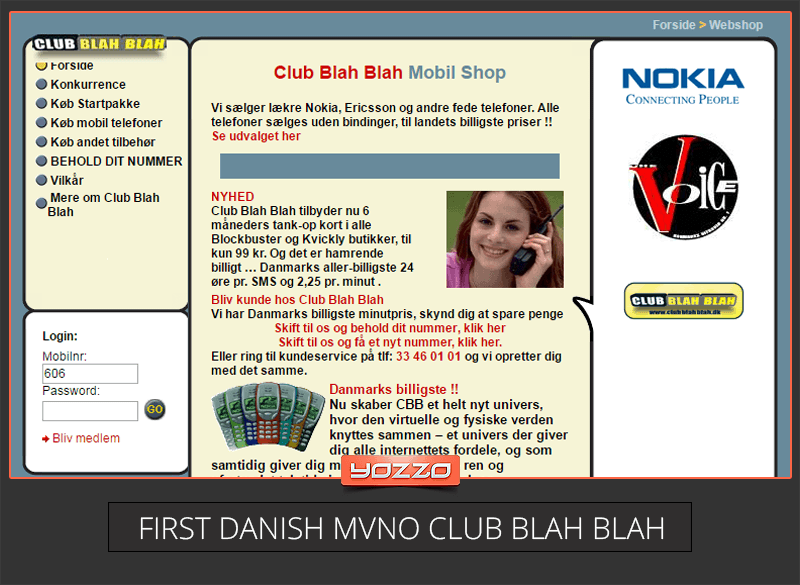


Telmore was founded by ICT entrepreneur, Frank Rasmussen and was Rasmussen’s second venture, after the internet service company Image Scandinavia (sold to World Online in 1999) – and would be the first of many MVNOs from his side.
The History of MVNO: Chronology of MVNO Launch Dates
| LAUNCH DATE | MVNO | HOST | COUNTRY |
| 11. November 1999 | Virgin Mobile UK | One2one | UK |
| 17. January 2000 | Sense | Telenor | Norway |
| 01 October 2000 | Club Blah Blah | Sonofon | Denmark |
| 09. October 2000 | Tele2 A/S | Sonofon | Denmark |
| 30. October 2000 | Telmore | TDC | Denmark |
The MVNO Concept Proved Successful
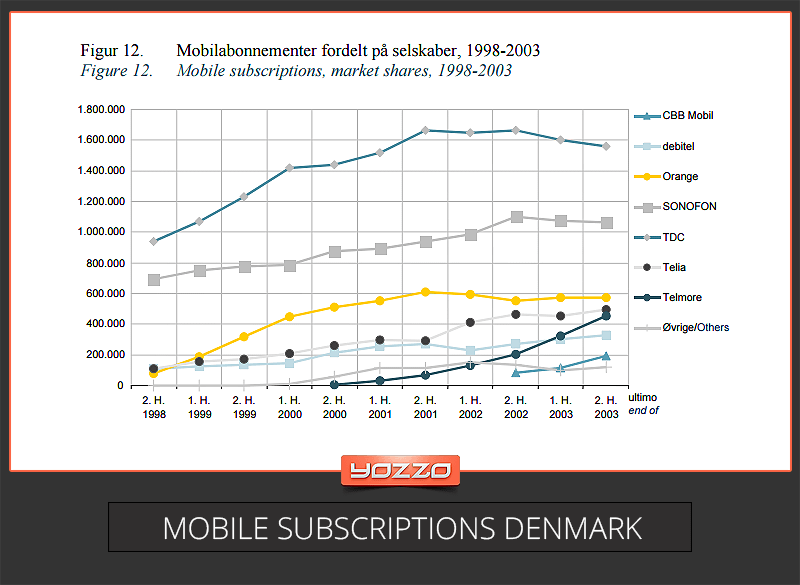
According to the Danish National IT and Telecoms Agency (Telestyrelsen)[10], the number of mobile subscriptions nationwide end of 2003, grew by 7% to a total of 4.785 million (88.9% penetration).
However, the collective customer base of the five Mobile Network Operators: TDC, Sonofon, Orange, Telia and Hi3G, fell by 2.4% to 3.69 million, while the three Danish MVNOs: Telmore, debitel and CBB Mobil, saw their combined subscriber base rise by a staggering 74% from 558,000 to 973,000.
Telmore alone, managed to attract an impressive market share of 9% (453.815).
Telmore - A textbook example of MVNO execution
Faced with falling subscriber additions, the Danish incumbent TDC, had been forced into competition, resulting in the average cost of a mobile voice minutes falling almost 50% in the last six months of 2003.
With 3G around the corner, the Danish mobile operators were looking at ways to inject much-needed growth into their operations, including acquisition.
The dominant Danish incumbent TDC, which at the time controlled around half of the market, made the move in December 2003, having already acquired 20% of Telmore in April 2003 for DKK 100 million (U$ 15,025,155), TDC bought the remaining 80% of Denmark’s leading MVNO Telmore.[11]
In total TDC paid DKK 400 million (U$ 60,131,000) to take over Telmore, and its 460,000 customers, which was DKK 869,50 (U$ 130.63) per subscriber.
Telmore has long been regarded as a textbook example of MVNO execution in a fiercely competitive market.[12][13]
With a small workforce (From 20 employees in 2001 to 70 in 2003), online distribution only, and no subsidized handsets, Telmore had far lower costs than established operators, which is the ABC in wholesale business.
The success of Telmore is underlined by its rapid growth from just 130,000 customers mid-2002, to 460,000 by the time TDC took over. In fact, the success and user satisfaction was so strong, that TDC still brands the former MVNO as Telmore today.
Between its launch in late 2000 and 2003 Telmore (and CBB Mobile) collectively acquired 43.7% of all new mobile customers in Denmark. They introduced competition into the market, resulting in prices falling 50% – but overall volumes of mobile traffic increasing. End of 2003 Telmore was responsible for 36% of all e-payments made in Denmark.[14]
Frank Rasmussen, the founder of Telmore went on to open the MVNO Bibob, which was launched in 2007 and sold to Telenor for DKK 93 million (U$ 13.96 million) in May 2009 when it had 69,000 subscribers.
In 2011 he launched MVNO Systems, a OSS/BSS solution for telecom operators and MVNO’s, which he sold the same year to Telenor. In 2014 he launched the MVNO Justfone, which TDC invested in, and TDC has also invested in Frank Rasmussen’s latest venture CubeIO, which is an app with a modern take on voicemail.
MVNO Club blah blah - CBB Mobil
The other Danish MVNO Club blah blah, changed its name to CBB Mobil, and had 191,639 customers at the end of 2003. CBB was also the subject of interest after putting itself up for sale at the end of January 2004.
Virgin Mobile and Telenor was mentioned as potential suitors by industry sources. However it was Sonofon (the host operator), who bought the MVNO for 130 million DKK. (U$ 19,546,625) in 2004.[15] Sonofon itself was rebranded to Telenor in 2005/2006.
MVNO Tele2
The MVNO Tele2, expanded its territory into Austria, the Netherlands and Central Europe, and is today a European telecommunications operator, with about 14 million customers in 9 countries.[16]
MVNO Sense
In Norway, Sense had obtained a 4.7% market share (180,000) in 2003.
It was sold to Chess Communication AS in 2005, and the following year, Chess/Sense (400,000 subscribers) was sold to TeliaSonera for NOK 1,619 billion (U$ 192,006,439)[17] which was NOK 4047,50 (U$ 477.50) per subscriber.
With the purchase, Telenor’s rival TeliaSonera immediately increased its market share to 38% while the now former host operator Telenor, was estimated to have lost 600-800 million NOK.
Virgin Mobile UK
In the UK, Virgin Mobile reported its Q3 2003 results:[18]
- Total customer base 3,183,347 (30. September 2003)
- 269,681 net connections (Q3 2003)
- Customer growth up 56% (2,013,382) QoQ
- Q3 2003 turnover of £112,6m
- 9 month EBITDA of £67m
- 9 month operating profit of £59m
- 9-month turnover of £309m
At the end of 2003, Virgin Mobile UK had managed to attract 7% of the UK mobile market (3,7 million).
Virgin Mobile was acquired by NTL Telewest in 2006, before joining the quad play of Virgin Media services, when NTL Telewest rebranded into Virgin Media in 2007.
As of March 2016 Virgin Mobile UK had 3.0 million mobile subscribers.[19]
The History and Future of MVNO
The liberalization and the introduction of MVNO’s has transformed telecommunication markets the world over. The benefits include price reductions, service innovation, greater consumer choice, and increased market penetration.
According to GSMA Intelligence,[20] between June 2010 and June 2015, the number of MVNOs worldwide increased by 70%, reaching 1,017 in June 2015.
The report further noted that the 10 countries with the largest number of MVNOs as of June 2015, was:
- Germany – 129 MVNOs
- U.S. – 108 MVNOs
- UK – 76 MVNOs
- Netherland – 56 MVNOs
- France – 49 MVNOs
- Australia – 43 MVNOs
- Denmark – 43 MVNOs
- Spain – 35 MVNOs
- Poland – 27 MVNOs
- Belgium – 26 MVNOs
The amount, and subscribers of mobile virtual network operators (MVNO) services has increased at a considerable pace over the past years. The number of MVNOs globally increased 61% between 2010 and 2018, representing an average annual growth rate of 6%.

In 2018 there were more than 1,300 active MVNOs operating in 80 countries, representing more than 220 million mobile connections – or approximately 2.46% of the total 8.9 billion mobile connections in the world.
The rate of progress seems to continue. Orbis Research estimated that the value of the global MVNO market was $54 billion in 2017, and is expected to reach a value of $84 billion dollars in 2022, which implies a compound annual growth rate (CAGR) of 9.27% during this period.
In line with increased mobile penetration and less organic growth in developed markets, the top eight MVNO countries in 2018: USA, Germany, Japan, UK, Australia, Spain, France and Denmark – made up more than half of the 1,300 active MVNOs worldwide.
Top 10 MVNO countries 2018
| COUNTRY | MARKET SHARE | ACTIVE MVNOs | YEARS WITH MVNO |
| USA | 4.7% | 139 | 17 |
| GERMANY | 19.5% | 135 | 18 |
| JAPAN | 10.6% | 83 | 18 |
| UK | 15.9% | 77 | 19 |
| AUSTRALIA | 13.1% | 66 | 18 |
| SPAIN | 11.5% | 63 | 13 |
| FRANCE | 11.2% | 53 | 18 |
| DENMARK | 34.6% | 49 | 18 |
| NETHERLANDS | 33.5% | 39 | 18 |
| RUSSIA | 5% | 37 | 16 |
The presence of MVNOs in developing countries has doubled in recent years. In 2010 MVNOs operated in 13 countries, while for the first half of 2018 they operated in more than 30 developing countries.
For year 2019/2020, especially the LATAM (Brazil, Mexico, Chile, Colombia) and APAC (Singapore, Vietnam, China) regions, has seen an increased growth in MVNO launches, while national telecom authorities in other markets i.e. Nigeria, Kuwait and Georgia are actively introducing MVNOs to foster competition and innovation in their markets.
MVNO History - Frequently Asked Questions
The emergence of MVNOs was primarily driven by the liberalization of telecommunications markets, particularly in Europe during the 1990s. Until the late 1980s, these markets were largely dominated by government-controlled monopolies.
A crucial turning point was Directive 95/62/EC of the European Parliament, 13 December 1995, which mandated “open network provision (ONP) to voice telephony.”
This directive required dominant market players (Mobile Network Operators or MNOs) to grant access to their networks on a transparent, fairly priced, and non-discriminatory basis.
By January 1, 1998, all EU telecom operators had the right to interconnect with public networks at cost-related charges. This regulatory push aimed to foster competition, break existing duopolies, and ultimately benefit consumers with lower prices and more choices, creating the essential conditions for MVNOs to operate.
Nordic countries, particularly Denmark and Norway, were pioneers in the conceptual development of MVNOs, even before the first commercial launch.
Denmark, for instance, liberalized its telecom market in July 1996, ahead of the EU deadline.
In 1998, the Norwegian company Sense Communication took “the first steps towards what we today know as Mobile Virtual Network Operator (MVNO)” by attempting to challenge the existing duopoly. Sense aimed to use its own Mobile Network Code (MNC) and SIM cards but faced resistance from MNOs who considered this “roaming” rather than “interconnection.”
Despite initial regulatory support in favor of Sense from the Norwegian, Danish, and Swedish National Telecommunications Authorities (NRAs), and their recognition that MVNOs could enhance competition, Sense initially “succumbed due to the lack of agreements with the operators” in March 1999.
However, Sense later re-emerged with a revised model and launched services in Norway in January 2000, demonstrating the early, albeit challenging, efforts in the region to establish virtual network operations.
The world’s first commercially launched MVNO was Virgin Mobile UK, which launched on November 11, 1999. This was a 50:50 joint venture between Virgin Group and Deutsche Telekom’s One2One.
Its launch was highly significant because it proved that “a company with a strong consumer brand, but no existing telecom infrastructure, could successfully leverage a network operator’s services to create a new business.”
Unlike earlier reseller arrangements that were typically inter-carrier partnerships, Virgin Mobile represented a new model where a brand from a completely separate industry entered the mobile market.
Virgin Mobile aimed for aggressive market entry, targeting 1 million customers by March 2000 with a £20 million advertising campaign and a transparent, single tariff structure.
By the end of 2003, it had captured 7% of the UK mobile market with 3.7 million customers, establishing a blueprint for future MVNO success.
Danish MVNOs, especially Telmore, became a “textbook example of MVNO execution in a fiercely competitive market” shortly after Virgin Mobile’s launch.
Telmore, alongside CBB Mobil and Tele2, launched in October 2000. By the end of 2003, while established MNOs saw their customer base decline, Danish MVNOs experienced a staggering 74 rise in combined subscribers, from 558,000 to 973,000.
Telmore alone achieved a 9% market share (453,815 subscribers).
Their disruptive growth was attributed to a lean operational model: a small workforce (20-70 employees), online-only distribution, and no subsidized handsets, resulting in “far lower costs than established operators.”
This enabled them to offer highly competitive pricing, leading to a “50% fall in prices” and a significant increase in mobile traffic. Between late 2000 and 2003, Telmore and CBB Mobile collectively acquired “43.7% of all new mobile customers in Denmark” and Telmore was “responsible for 36% of all e-payments made in Denmark” by the end of 2003, demonstrating their profound market impact.
The rapid success of early Danish MVNOs like Telmore and CBB Mobil eventually led to their acquisition by the very MNOs they disrupted.
TDC acquired 100% of Telmore in December 2003 for DKK 400 million, valuing each subscriber at approximately DKK 869.50 (U$130.63).
Similarly, Sonofon (later Telenor) acquired CBB Mobil for DKK 130 million in 2004.
This signifies a common pattern in mature MVNO markets: successful virtual operators prove the viability of their business model and attract a significant customer base, prompting MNOs to acquire them to regain market share, eliminate competition, or integrate these successful, agile models into their own offerings.
These acquisitions validated the MVNO model as a powerful tool for market disruption and growth, ultimately benefiting the MNOs willing to embrace or acquire them.
The regulatory environment evolved significantly to accommodate MVNOs, largely in response to early challenges faced by pioneers like Sense Communication.
Initially, MNOs often resisted MVNOs by defining their proposed operations (e.g., using their own SIM cards) as “roaming” rather than “interconnection,” thus denying network access.
However, National Telecommunications Authorities (NRAs) in countries like Norway, Denmark, and Sweden quickly recognized the potential of MVNOs to foster competition and reduce “socioeconomic loss as a result of the lack of effective competition.”
The UK’s Office of Telecommunications (Oftel) observed these “regulatory issues” and launched consultations in June 1999 to facilitate MVNO entry. This regulatory recognition and subsequent support, spurred by directives like Directive 95/62/EC, which mandated non-discriminatory network access, eventually led to the development of clearer frameworks that obliged MNOs to provide access to MVNOs, paving the way for their global growth.
Since their inception in the late 1990s, MVNOs have experienced exponential global growth and have profoundly transformed telecommunication markets.
The number of MVNOs worldwide increased by 70% between June 2010 and June 2015, reaching over 1,000.
By 2018, there were “more than 1,300 active MVNOs operating in 80 countries, representing more than 220 million mobile connections.”
This growth has led to “price reductions, service innovation, greater consumer choice, and increased market penetration.”
The global MVNO market was valued at $54 billion in 2017 and is projected to reach $84 billion in 2022, indicating a strong Compound Annual Growth Rate (CAGR) of 9.27%.
Leading MVNO markets in 2018 included Germany, the USA, Japan, and Denmark (which had a significant 34.6% market share). MVNO presence has also doubled in developing countries between 2010 and 2018, with regions like LATAM and APAC seeing increased launches, often actively encouraged by national telecom authorities to boost competition.
At the of of 2023, there were more than 2,000 MVNOs in 90 countries.
MVNOs contribute significantly to market competitiveness and offer substantial benefits to consumers by challenging the traditional MNO duopolies or oligopolies.
By leveraging existing network infrastructure, MVNOs introduce a new layer of competition without the heavy investment in physical networks. This “asset-light” model allows them to focus on niche markets, offer innovative services, and operate with lower overheads, which translates directly into “price reductions” for end-users.
For instance, Telmore’s entry in Denmark led to mobile voice minute costs falling by “almost 50%.”
Beyond price, MVNOs drive “service innovation” and provide “greater consumer choice” by catering to diverse segments with tailored plans, unique branding, and simplified tariff structures (like Virgin Mobile’s single tariff). Their presence also leads to “increased market penetration” by making mobile services more accessible and affordable, ultimately transforming telecom markets worldwide.
MVNO History - Additional Information
References
1. Directive 95/62/EC of the European Parliament, 13 December 1995 – The application of open network provision (ONP) to voice telephony
2. Competition Policy in Telecommunications: The case of Denmark | International Telecommunication Union (ITU) | PDF
3. Ikke tilstrekkelig konkurranse på mobiltelefoni | Digi.no | 30. September, 1998
4. Sense får samtrafikk – ikke roaming | Digi.no | 16. February, 1999
5. Sense ved stupet | Digi.no | 27. February, 1999
6. Slutt for Sense | Digi.no | 17. March, 1999
7. Sense selges for noen millioner | Digi.no | 7. April, 1999
8. Sense lover å bryte mobilduopolet | Digi.no | 17. January, 2000
9. Virgin shakes up mobile market with One2One deal | The Register | 11 November, 1999
10. National IT and Telecom Agency, Denmark (IT- og Telestyrelsen) | Telecom Statistics – Second half of 2003 | PDF
11. TDC acquires 100% of Telmore | TDC Press Release | sec.gov
12. From Strategy to Business Models and to Tactics | Harvard Business School | Ramon Casadesus-Masanell, Joan Enric Ricart | 2009 | PDF
13. Telmore – Disruption in the Danish Mobile Market | Case Study | European School of Management and Technology | Jamie Anderson | 2004 | PDF
14. Fremgang for e-handel i Danmark skyldes ét firma | Computerworld.dk | 29 January, 2003
15. SONOFON acquires CBB Mobil | Telenor Press Release |30 april 2004
16. Tele2 | Wikipedia
17. Chess-salget endelig i boks etter priskutt | Digi.no | 29 August, 2005
18. Virgin Mobile enjoys its best ever Q3 – and pips Orange! | Internet Archive
19. Virgin Media | Corporate
20. Report: Number of MVNOs exceeds 1,000 globally | FierceWireless | 2 September, 2015
See Also:
- Introduction to MVNA, MVNE, MVNO
- MVNA MVNE MVNO Explained
- MVNO Strategy: Market Differentiation and Segmentation
- MVNO Objectives: Generate telecoms revenues or cross-sell core business
- MNO & MVNO Partnerships: From Old Fears to New Revenue
- MVNO Business Models
- MVNO Types & Operational Models
- Reseller MVNO (Branded Reseller)
- Service Provider MVNO (Thin MVNO)
- Enhanced Service Provider MVNO (Medium MVNO)
- Full MVNO
- Mobile Virtual Network Aggregator (MVNA)
- Mobile Virtual Network Enabler (MVNE)